
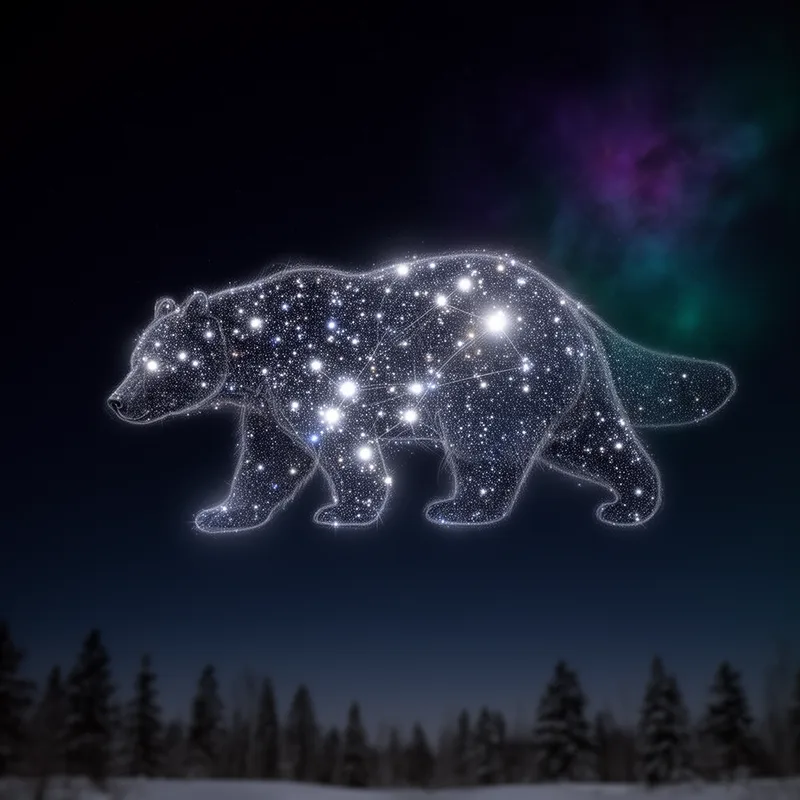
Ursa Major


 1
7.3
1
7.3
- proper noun
- /ˈɜr.sə ˈmeɪ.dʒər/
- That's Ursa Major, the Big Bear.
- Ursa Major constellation
- Ursa Major, the Great Bear
- Ursa Major, the Big Dipper
Examples
-
The outline of Ursa Major can be easily recognized by its distinct shape in the night sky.
-
The stars in Ursa Major, also known as the Great Bear, are clearly visible during the summer nights.
-
Above us, Ursa Major began its revolution through the night sky.
Fiction book (1999) -
Ursa Major is the Great Bear.
Fiction book (1999) -
Accordingly, the magical number seven is prominent in all the rites, a reminder of the seven major stars in the constellation of the Great Bear (Ursa Major) in the heavens.
Academic text (1993) -
In ancient mythology, Ursa Major was often associated with a bear and represented in various cultures.
Synonyms

A large group of stars in the northern sky that includes the Big Dipper
Surface Forms
Morphology
The name is compositionally transparent: 'Ursa' (Latin for 'bear') + 'major' (greater/big) yields the literal sense 'Great Bear', which directly identifies the constellation. This descriptive, cross-linguistically common naming pattern in astronomy makes the meaning accessible to a B1 learner who knows both constituents.
Etymology
Ursa Major comes from Latin words Ursa meaning 'bear' and Major meaning 'greater'. People long ago saw a group of stars that looked like a bear and told a sky story about it, so today Ursa Major is the large group of stars we still call the 'great bear'.