
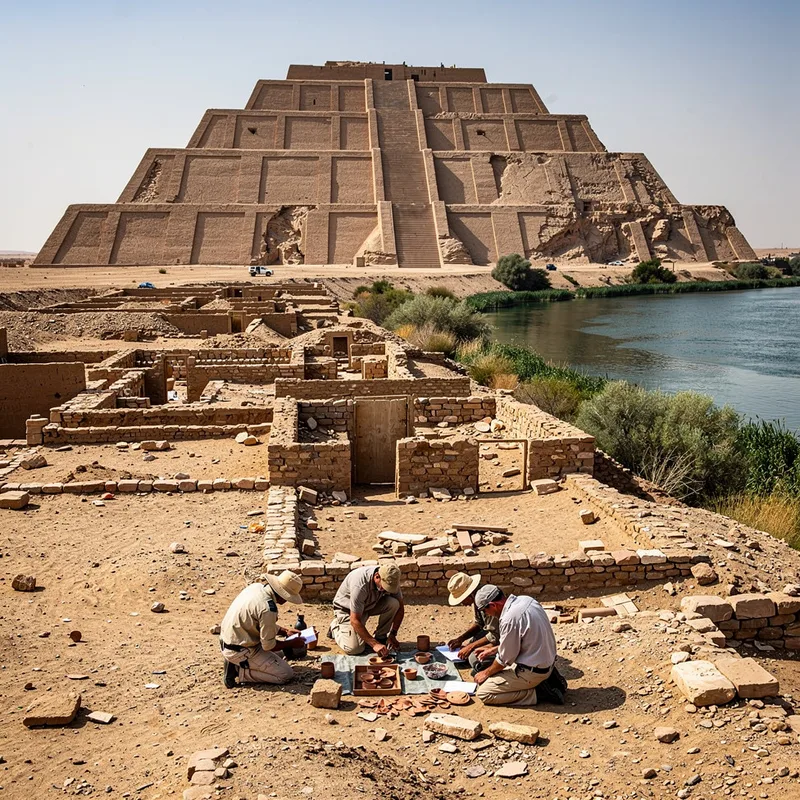
Ur
 14
9.9

- proper noun
- /ɜr/
- I am the Lord that brought thee... out of Ur of the Chaldees... to give thee this land to inherit it.
- Ur-Nammu
- Dynasty of Ur
- Ur in 2004 B.C.
Examples
-
But in Ur, we were free to wander and enjoy a few rare moments of peace.
Academic text (2011) -
There has not been an excavation at Ur since.
Academic text (2011) -
Our visit to Ur was short.
Academic text (2011) -
By the time I was playing on the remnants of ancient Ur, many environmental changes had taken place.
Academic text (2007) -
In 2009, U.S. military authorities turned the site of Ur over to the Iraq State Board of Antiquities and Heritage.
Academic text (2011) -
He was born in Ur of the Chaldees.
-
In 2047 B.C., Ur became the capital of its own centralized state, ruled by what historians call the Ur III dynasty.
Academic text (2011) -
I stopped for one night to see Ur of the Chaldees, and for three days in Baghdad with the A.O.C., who happens to be a friend of mine.
-
Around 2250 B.C., Sargon the Great made Ur part of his Akkadian empire, one of the world's first centralized states.
Academic text (2011) -
Abraham was born in the ancient city of Ur, which is located in present-day Iraq.
Surface Forms
Etymology
Ur comes from the ancient Sumerian name Unug, also written Urim, which meant something like 'city' or 'settlement', so it reminds us that Ur was one of the world's first cities.