
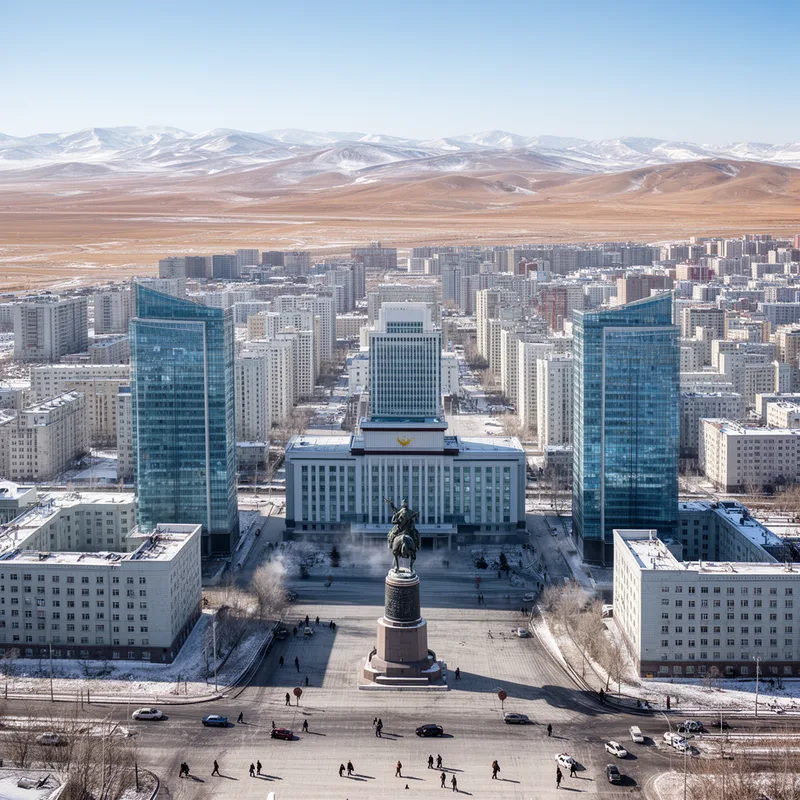
Ulaanbaatar


 1
8.5
- proper noun
- /uˈlɑːnˌbɑːtər/
- As the capital of Mongolia, Ulaanbaatar serves as the political, cultural, and economic center of the country.
- Ulaanbaatar City
- development in Ulaanbaatar
- Ulaanbaatar City Development Strategy
Examples
-
The Ulaanbaatar Master Plan, approved in 2001, is also part of CDS.
Academic text (2006) -
Only three aimags and the city of Ulaanbaatar make positive contributions to the state budget.
Academic text (2006) -
The central region, including Ulaanbaatar, contains more than 60 percent of the population.
Academic text (2006) -
In 2001, the government approved a development strategy for Ulaanbaatar city.
Academic text (2006) -
Of its 2.3 million citizens, approximately 38 percent are in Ulaanbaatar.
Academic text (2006) -
We caught that gentleman four days ago in Ulaanbaatar, Mongolia.
-
In Ulaanbaatar, both kinds appear to be available, and the same is true of secondary cities.
Academic text (2006) -
Accurate and reliable information and data on environmental quality are limited for Ulaanbaatar and even scarcer for secondary cities.
Academic text (2006) -
However, neither local nor central authorities measure particulate concentrations anywhere outside of Ulaanbaatar.
Academic text (2006) -
Based on household income and GDP per capita, households in Ulaanbaatar are, on average, better off than the rest of the country, but Ulaanbaatar still has a higher number of the "very poor" compared with the national average.
Academic text (2006)
Synonyms
 1
5.2
The capital and largest city of Mongolia on the Tuul River
Surface Forms
Etymology
Ulaanbaatar comes from Mongolian parts Ulaan 'red' and Baatar 'hero'. It was named to honor a famous hero, so the capital's name means 'Red Hero', which makes it easy to remember as Mongolia's main city.