
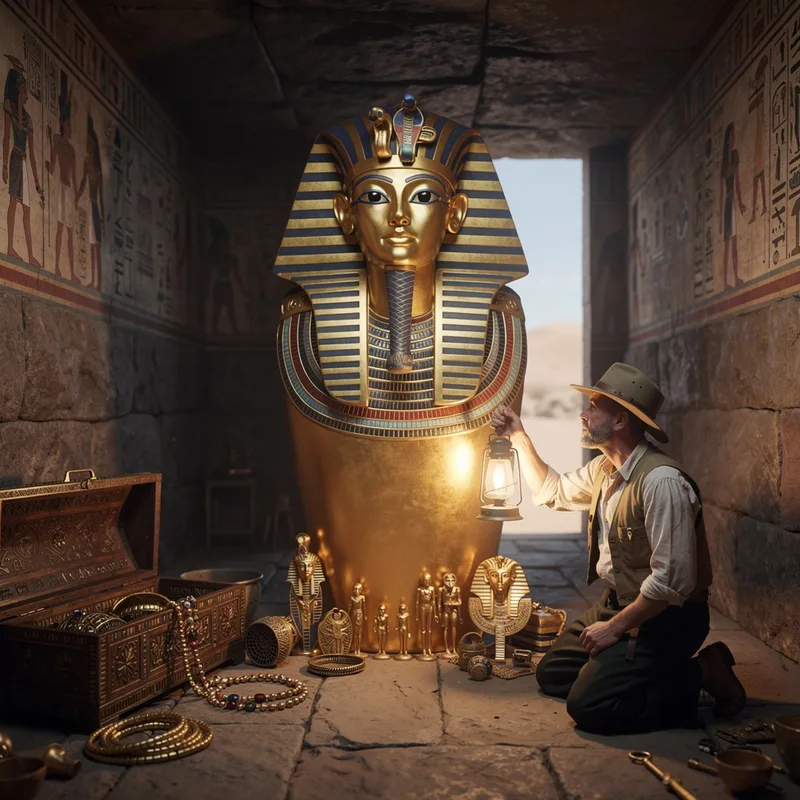
Tutankhamen
 5
8.8

- proper noun
- /ˌtuːtənˈkɑːmən/
- You know, it's like going into Tutankhamen's tomb and finding the mummy.
- King Tutankhamen
- Nefertiti and Tutankhamen
- Akhenaten and Tutankhamen
Examples
-
The discovery of Tutankhamen's tomb in 1922 changed our understanding of ancient Egypt.
-
Tutankhamen and the Golden Age of the Pharaohs, May 26, 2006 - January 1, 2007, Field Museum, Chicago, IL.
Academic text (2005) -
As important a find as the tomb of Tutankhamen.
-
Code Tut, as in King Tutankhamen.
-
Come, if we hurry, we can see tutankhamen's tomb before closing.
-
Permit me to present you with the most sensational find since that of Tutankhamen.
-
Six complete (although dismantled) chariots were retrieved from the tomb of Tutankhamen.
Academic text (2004) -
Many tourists visit Egypt to see the treasures of Tutankhamen displayed in the museum.
-
Tutankhamen became pharaoh at a young age, leading to significant historical interest.
Synonyms
 2
8.6
An Egyptian king of the eighteenth dynasty known for his nearly intact tomb found in 1922
Surface Forms
Etymology
Tutankhamen comes from ancient Egyptian parts Tut, ankh, and Amun, which mean 'image', 'life', and the name of the god 'Amun'. So his name means 'living image of Amun', showing that a pharaoh was seen as a god on earth.