
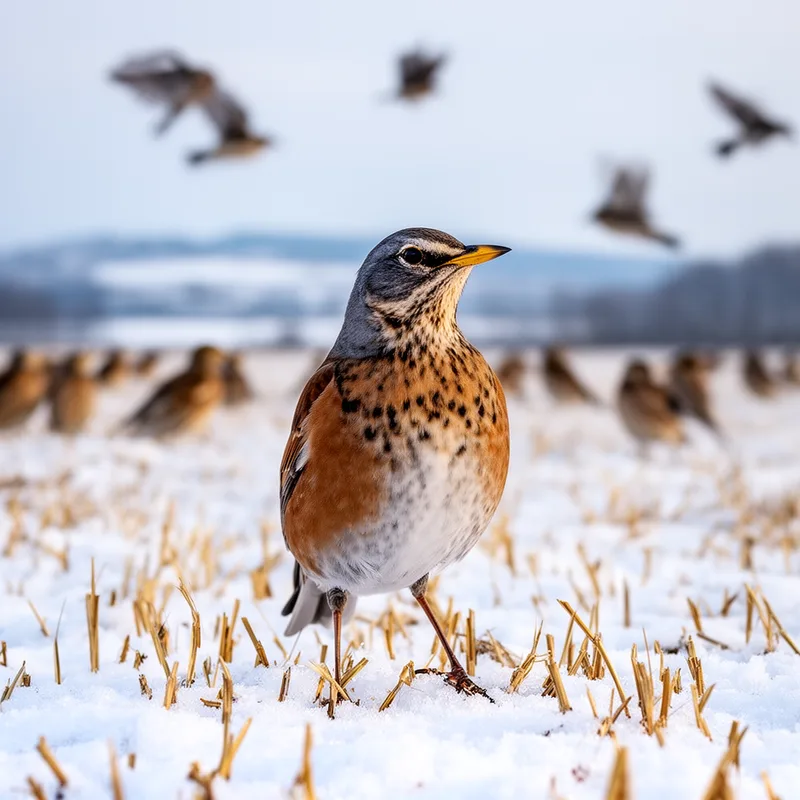
Turdus pilaris
- noun
- Specialized
- Large flocks of Turdus pilaris arrive from Scandinavia each winter.
Examples
-
The Turdus pilaris is often seen in flocks during the winter months.
-
The distinctive calls of Turdus pilaris can be heard in open countryside.
-
Researchers monitored the migration patterns of Turdus pilaris over several years.
-
Have you ever spotted a Turdus pilaris in your garden?
-
During the cold months, Turdus pilaris can often be found foraging in fields.
-
Birdwatchers enjoy observing Turdus pilaris as it migrates across Europe each winter.
-
In winter, Turdus pilaris gathers in large groups, making it easy to spot them.
Synonyms

A medium-sized bird with a grey head and tail area seen in winter
Surface Forms
Morphology
Turdus + pilaris
This is a Latin binomial (scientific) name where the genus label 'Turdus' and the species epithet 'pilaris' do not compose into an English-language meaning; 'pilaris' has no lexical definition in English and the form functions as an arbitrary taxonomic label. Scientific names are not semantically compositional for average B1 learners, so knowing the parts would not let them infer the common-name meaning 'fieldfare'.
Etymology
Turdus pilaris comes from old Latin words: Turdus means 'thrush' and pilaris may come from a word for 'hair' or a small 'cap', likely pointing to the bird's head markings. So the name gives the image of a thrush with a marked head, which helps explain why this name fits the fieldfare.

