
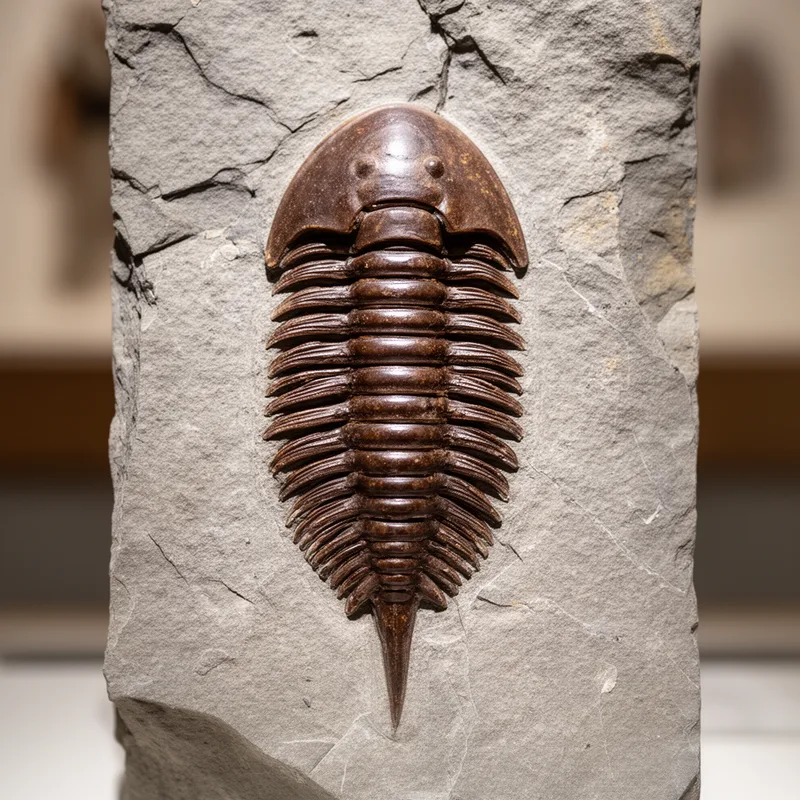
Triarthrus
- proper noun
- Specialized
- The inch-long trilobite Triarthrus scavenged organic debris from the sediment and captured worms and other soft, nonshelly prey.
- Triarthrus trilobite
Examples
-
The spines along the inner margins of its legs probably helped Triarthrus to capture small prey animals, which were shunted from leg to leg along the belly to the mouth.
Academic text (1992) -
A biologist transported back in time to the Ordovician seabed near Rome, New York, would have regarded Triarthrus as a "living fossil" even then.
Academic text (1992) -
What ultimately caused the extinction of Triarthrus?
Academic text (1992) -
The last known species of Triarthrus, however, lived in a single basin in southern Ontario.
Academic text (1992) -
With a complete lack of oxygen, even the well-adapted Triarthrus would have died out.
Academic text (1992) -
Even after the extinction of Triarthrus, other kinds of trilobites lived on.
Academic text (1992) -
Adult Cornuproetus and the youngest stages of Triarthrus were not buried and must have lived elsewhere.
Academic text (1992) -
In contrast, Triarthrus was dominant among the adult trilobites but unknown in the bed in its earliest larval form.
Academic text (1992) -
Adult Triarthrus and baby Cornuproetus lived on the sediment, and both were overwhelmed by the influx of mud that buried and preserved them.
Academic text (1992) -
The inch-long trilobite Triarthrus scavenged organic debris from the sediment and captured worms and other soft, nonshelly prey.
Surface Forms
Etymology
Triarthrus comes from Greek parts tri- meaning 'three' and arthr- meaning 'joint', like triangle for 'three' and arthritis for 'joint'. So the name points to the trilobite's three-part or jointed body and helps you remember it is an ancient segmented sea creature.

