

Trapa natans
- noun
- Specialized
- The seeds of Trapa natans are edible and have been used as a food source in Asia for centuries.
Examples
-
Researchers study how Trapa natans spreads quickly in freshwater environments, threatening native plant species.
-
Lakes overrun with Trapa natans can suffer from reduced oxygen levels and decreased biodiversity.
-
The Trapa natans is often found in shallow waters.
-
Have you ever tasted Trapa natans seeds?
-
The seeds of Trapa natans are commonly eaten in Asian cuisine and are known for their crunchy texture.
-
Many people enjoy harvesting Trapa natans from lakes to cook in traditional dishes.
-
In some regions, Trapa natans is cultivated for its nutritious seeds and unique flavor.
Synonyms

A water plant with hard spiny fruit that people eat

A water plant with spiky four-part nuts that people eat

A plant that grows in water and makes a hard horned nut people eat
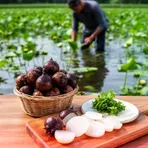
A type of water chestnut grown in ponds and eaten as a vegetable
Surface Forms
Morphology
Trapa + natans
This is a Latin binomial (scientific) name whose parts are treated as a proper noun rather than an English compositional phrase, and one constituent ('natans') is not a regular English word in the input. A B1 learner who only knows the listed constituent entries would not be able to infer 'a species of aquatic plant' from them; although 'natans' historically means 'swimming' in Latin, that knowledge is unlikely at B1 and does not make the name transparently descriptive in English.
Etymology
Trapa natans may give a simple picture: Trapa sounds like 'trap' because the plant's hard, spiky seed pods can catch a foot, and natans means 'floating', so the name points to a floating plant with nut-like seeds that people eat.

