
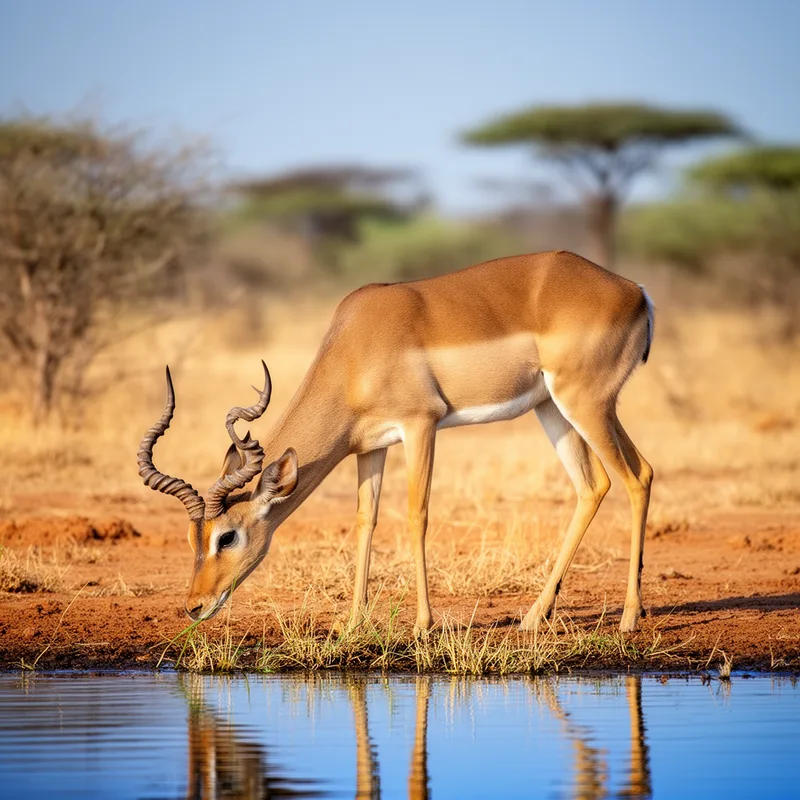
Tragelaphus imberbis
- noun
- Specialized
- Unlike the greater kudu, the Tragelaphus imberbis has a more slender appearance and shorter horns.
Examples
-
The Tragelaphus imberbis is known for its striking spiral horns and slender body.
-
The Tragelaphus imberbis inhabits dry, scrub woodlands in eastern Africa.
-
Researchers observed a Tragelaphus imberbis grazing quietly by a waterhole.
-
The Tragelaphus imberbis is often found in wooded areas.
-
Have you ever seen a Tragelaphus imberbis in the wild?
-
In the early morning, a Tragelaphus imberbis can be seen gracefully moving through the dense bushes.
-
During a safari, the guide pointed out a Tragelaphus imberbis resting under a tree.
Synonyms

A small African animal like a deer with white stripes and spiral horns that lives in dry woodlands
Surface Forms
Morphology
Tragelaphus + imberbis
This is a scientific binomial (a taxonomic proper name) rather than a compositional English phrase; its meaning as 'the lesser kudu' depends on specialized biological knowledge and convention, not on ordinary combinatory semantics. The second element 'imberbis' is not a regular English word (dictionary entry missing), so even a learner who knows 'Tragelaphus' would not reliably infer the species identity or properties from the constituents alone.
Etymology
Tragelaphus imberbis: The name comes from older words — Tragelaphus mixes Greek words for 'goat' and 'deer', and imberbis is Latin for 'without a beard'. So the name paints a simple picture: a deer-like animal with goat-like, twisted horns and little or no chin beard, which helps explain why this antelope got that name.

