
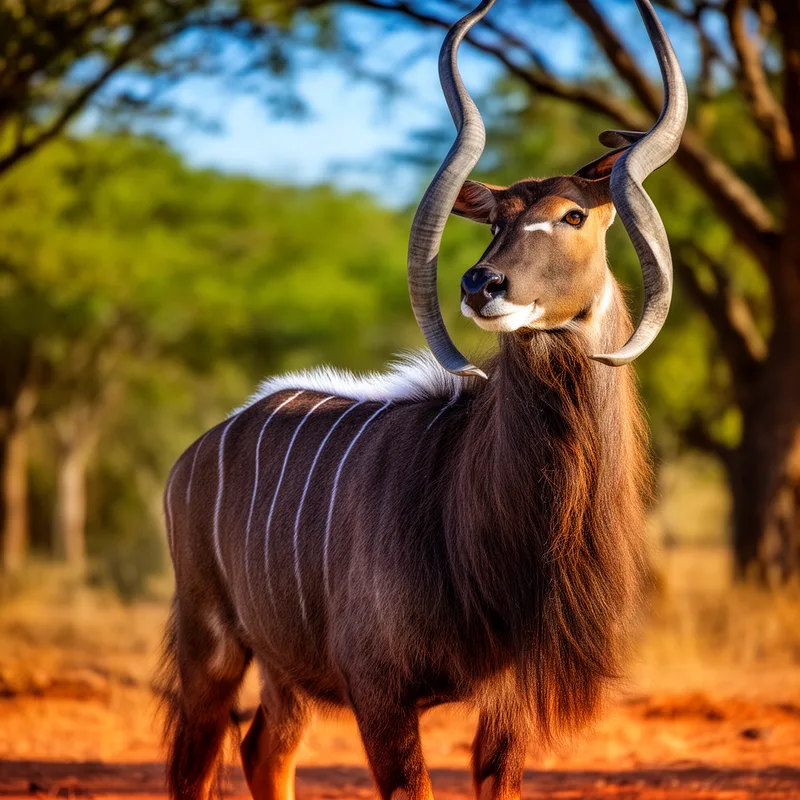
Tragelaphus angasi
- noun
- Specialized
 :
nyala
:
nyala
- Male Tragelaphus angasi can be easily identified by their striking spiral horns and shaggy coats.
Examples
-
The Tragelaphus angasi is commonly found in the dense woodlands of southern Africa.
-
Wildlife photographers often seek out Tragelaphus angasi for its distinctive appearance and elusive nature.
-
The Tragelaphus angasi is a unique antelope species.
-
Did you see a Tragelaphus angasi at the zoo?
-
The male Tragelaphus angasi displays impressive spiral horns that make it easily recognizable.
-
In the wild, a Tragelaphus angasi can often be seen grazing in the early morning light.
-
Tourists visiting South Africa are excited to catch a glimpse of the elusive Tragelaphus angasi in its natural habitat.
Synonyms
 1
9.9
1
9.9

A large African antelope with spiral horns and a white hair fringe along its back
Surface Forms
Morphology
Tragelaphus + angasi
Knowing 'Tragelaphus' as a genus of spiral-horned antelopes allows a learner to infer that 'Tragelaphus angasi' names a particular species within that group (i.e., a kind of antelope). However, the species epithet 'angasi' is an arbitrary taxonomic label with no transparent lexical meaning, so the precise sense (the nyala and its specific features) cannot be derived from the parts alone.
Etymology
Tragelaphus angasi may come from old Greek words tragos and elaphos, which mean 'goat' and 'deer' and give the picture of an animal with twisted horns. The second part 'angasi' honors a man named George Angas who first described the animal, so the name fits the spiral-horned antelope we call the 'nyala'.