
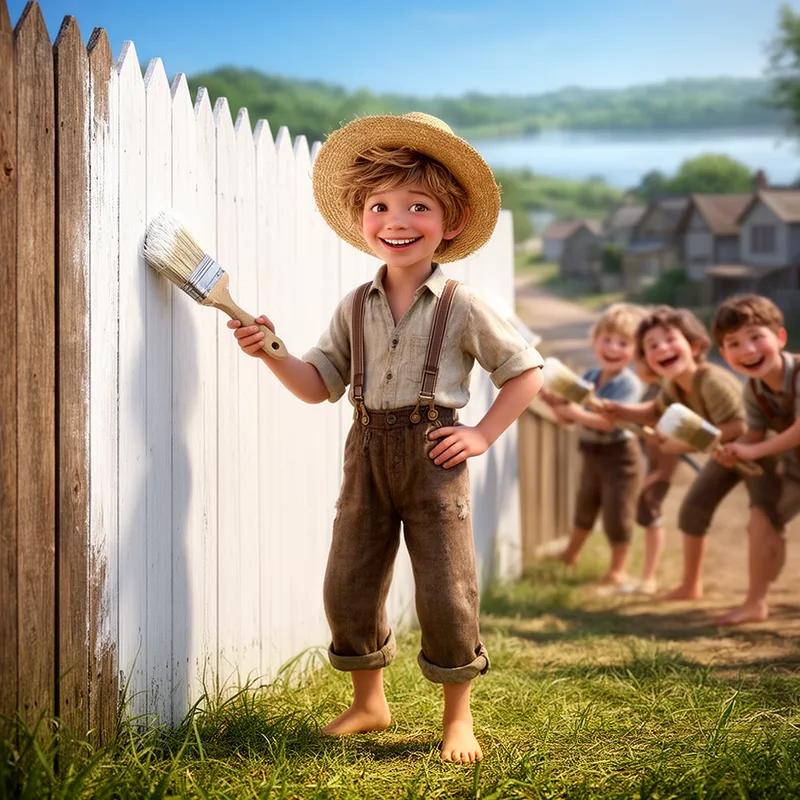
Tom Sawyer
 11
4.3

- proper noun
- /tɑm ˈsɔɪər/
- Literature
- That's the kind of mischievous boy Tom Sawyer was.
Examples
-
You're about to hear the incredible story of Tom Sawyer.
Fiction book (2001) -
Becky: I'm sure that's not true, Tom Sawyer, but thank you.
Fiction book (2001) -
Do you know anyone like Tom Sawyer?
Fiction book (2001) -
-It's a sequel to Tom Sawyer.
-
All I know is, it suits Tom Sawyer just fine.
Fiction book (2001) -
Narrator 2: Tom Sawyer was the sort of boy who craved adventure, and it was always getting him.
Fiction book (2001) -
Mark Twain created one of America's best-loved troublemakers, Tom Sawyer, 125 years ago.
Fiction book (2001) -
A catastrophic loss of fortune had driven him abroad; the fortune he had earned as the author of celebrated travel books and founder of the Tom Sawyer/Huckleberry Finn mythos.
Fiction book (2001) -
And that's the end of this tale, but there's plenty more of Tom Sawyer—seeking buried treasure, scheming with Huck Finn, and much more adventure.
Fiction book (2001) -
In Mark Twain's novel, the adventurous boy hero Tom Sawyer often finds himself in trouble due to his mischievous nature.
Surface Forms
Morphology
Tom + Sawyer
This is a proper name referring to a specific literary character, not a compositional phrase; knowing 'Tom' (a male given name) and 'sawyer' (an occupation) does not allow a learner to infer 'the adventurous boy hero of Mark Twain's novel.' As a fixed cultural/literary reference rather than a predictable combination of meanings, a B1 learner would not be able to derive the MWE's sense from its parts.
Etymology
Tom Sawyer comes from Mark Twain's book about a clever, adventurous boy by the Mississippi River. One famous scene shows Tom getting friends to do the work of whitewashing the fence, which gives a clear picture of his playful tricks, so Tom Sawyer now suggests 'a mischievous, clever youngster'.