
Tocharian
- noun
- Specialized
- Detailed studies show that Tocharian is much more closely related to the European languages than it is to Iranian or Indian tongues, and that it likely splintered off as a separate language in Europe some 5,600 years ago.
Examples
-
Tocharian belongs to the Indo-European language family, which includes many languages from Europe, Iran, and northern India.
Academic text (2010) -
Mair believes that the beauty of Xiaohe and her kin spoke an early form of Tocharian.
Academic text (2010) -
In the bleak desert, Uyghur refugees encountered small relic populations of Tocharians, who were struggling by then in a hostile climate.
Academic text (2010) -
While some Tocharians may have married into Uyghur families, giving rise to European-looking descendants, many Tocharians, according to historical records, either perished or fled the region after Uyghur attacks.
Academic text (2010) -
While some Tocharians may have married into Uyghur families, giving rise to European-looking descendants, many Tocharians, according to historical records, either perished or fled the region after Uyghur attacks.
Academic text (2010) -
The Tocharian languages are believed to have been spoken by people who lived in regions of what is now western China.
-
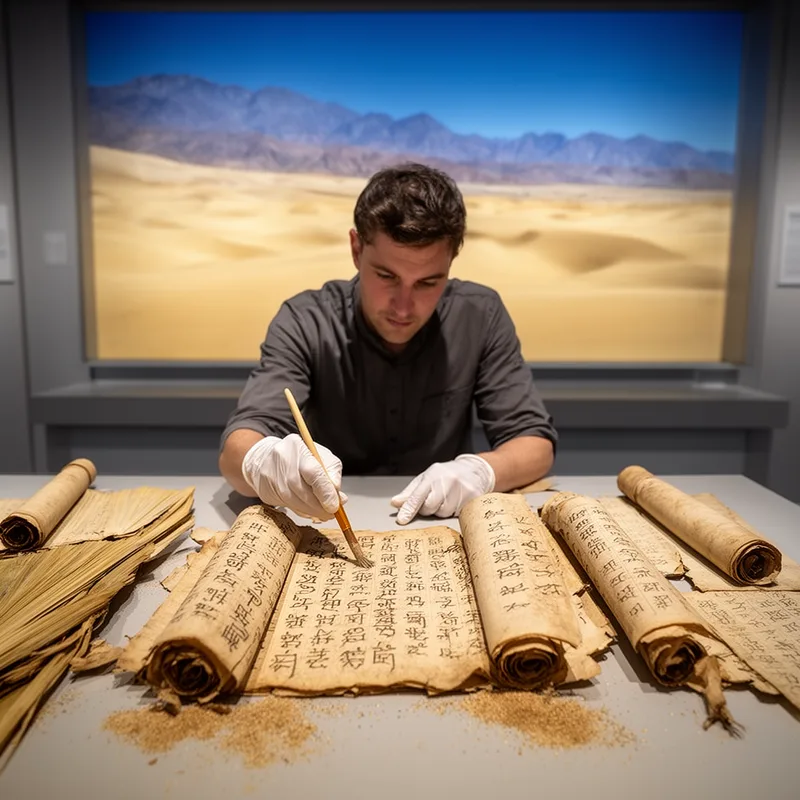
Linguists have discovered many ancient texts written in Tocharian that provide insights into early cultures in central Asia.
-
Tocharian is an important part of the study of Indo-European languages due to its unique characteristics.
Compounds

- Specialized
An eastern dialect of the dead Tocharian language spoken long ago in the Turpan area of Xinjiang, China

- Archaic
The western dialect of a language no longer spoken in parts of Central Asia
Surface Forms
Morphology
Tocharian = Tochar (transparent) = tochar + ian
Formed by the productive suffix '-ian' meaning 'related to' an ethnonym; the relation is structurally regular even though the ethnonym itself is obscure to most learners.
Etymology
Tocharian gets its name from an ancient people called the Tokharoi, a name known from Greek writers. Scholars later used that name for the old Indo-European languages found in the Tarim Basin in Central Asia, so Tocharian now means those ancient languages.

