

Tillandsia usneoides
- noun
- /tɪˈlændziə ʌsˈniːoʊɪdz/
- Specialized
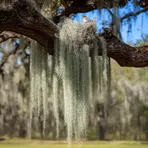
- Tillandsia usneoides hangs gracefully from the branches of live oaks in the southern United States.
Examples
-
Gardeners often cultivate Tillandsia usneoides for its ornamental appearance and minimal soil requirements.
-
The Tillandsia usneoides drapes beautifully from the oak trees.
-
Tillandsia usneoides drapes majestically from oak trees throughout the southern United States.
-
Researchers studied the air purification properties of Tillandsia usneoides in urban environments.
-
Look at that beautiful Tillandsia usneoides!
-
The long, gray-green strands of Tillandsia usneoides create a beautiful canopy in warm climates.
-
You can often find Tillandsia usneoides adorning trees in misty forests across the southeastern United States.
Synonyms
 2
6.7
2
6.7

A plant with long grey-green strands like hair that hang from tree branches
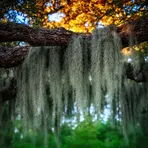
A hanging plant with soft gray-green strands that drape from tree branches
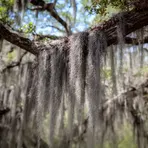
A plant with long thin grey threads that hang from tree branches
Surface Forms
Morphology
Tillandsia + usneoides
This is a Latin binomial (taxonomic) name functioning as a proper noun: even if a learner recognizes 'Tillandsia' as a genus of air plants, the species epithet 'usneoides' is not transparently interpretable and the full label refers specifically to Spanish moss and its appearance, which cannot be derived from the parts. Taxonomic names act as arbitrary labels across languages, so a B1 learner knowing the constituents would not be able to infer the MWE's specific meaning.
Etymology
Tillandsia usneoides is often called 'Spanish moss' because its long, gray strands hang from tree branches like a beard. One popular story says early English settlers thought it looked like the gray beards of people from Spain, and that picture is why the plant is known for hanging like hair on trees.