

Thujopsis dolobrata
- proper noun
- Specialized
- The garden's centerpiece is a beautiful Thujopsis dolobrata that stands out among the other evergreens.
Examples
-
Botanists admire the slow growth and ornamental value of Thujopsis dolobrata in Japanese gardens.
-
The Thujopsis dolobrata is known for its beautiful, feathery leaves.
-
Many landscapers choose Thujopsis dolobrata for its unique foliage and resistance to pests.
-
Look at that Thujopsis dolobrata!
-
Many landscapers appreciate Thujopsis dolobrata for its striking appearance and ability to thrive in various soils.
-
The lush foliage of Thujopsis dolobrata makes it a popular choice for ornamental gardens in Japan.
-
Garden enthusiasts often plant Thujopsis dolobrata to add a unique touch to their landscapes.
Synonyms
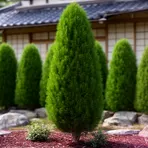
A slow growing evergreen tree from Japan grown in gardens for its dense green leaves
Surface Forms
Morphology
Thujopsis + dolobrata
This is a Latin binomial (genus + species). A learner who knows 'Thujopsis' can infer it names a type of that tree, but the specific epithet 'dolobrata' has no obvious English meaning (not in the dictionary) and the detailed descriptive sense (slow‑growing, medium‑large evergreen ornamental) cannot be derived from the parts, so the meaning is only partially recoverable.
Etymology
Thujopsis dolobrata may come from two old words: Thujopsis means 'looks like Thuja' and dolobrata may come from a Latin word for 'little axe', a picture of the tree's flat, blade-like leaves. So the name helps you remember this slow-growing evergreen often used for its neat, decorative foliage.

