
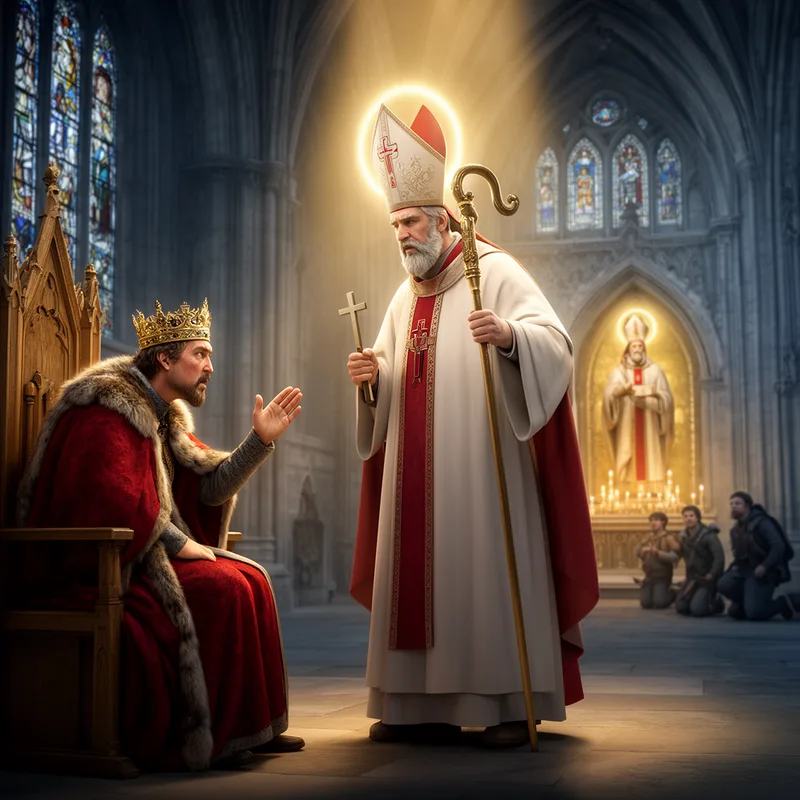
Thomas à Becket
- proper noun
- /ˈtɑːməs ə ˈbɛkɪt/
- Thomas à Becket famously clashed with King Henry II over the authority of the church and was ultimately killed for his beliefs.
Examples
-
Pilgrims visited Canterbury Cathedral to honor Thomas à Becket after his martyrdom.
-
Thomas à Becket became a symbol of resistance to royal interference in the Church.
-
The story of Thomas à Becket has inspired countless plays and books.
-
The story of Thomas à Becket is fascinating.
-
Did King Henry II really oppose Thomas à Becket?
-
Many pilgrims visit Canterbury Cathedral each year to pay their respects to Thomas à Becket, who is recognized as a martyr.
-
The legacy of Thomas à Becket continues to evoke discussions about the relationship between church and state in England.
Synonyms
 1
9.0

An English church leader who became archbishop of Canterbury and was killed after opposing King Henry II

 1
7.8
A senior church leader in England who was killed after arguing with King Henry II about the Church's rights
An Archbishop of Canterbury who was killed after opposing the king and later became a saint

A senior church leader in Canterbury remembered as a saint for being killed defending the Church against the king
Surface Forms
Morphology
Thomas + à + Becket
This is a personal name rather than a compositional phrase: knowing the parts 'Thomas', 'à', and 'Becket' does not let a learner infer that this refers to a 12th-century Archbishop of Canterbury who was murdered and later venerated. Proper names are referential and convention-based (and 'à' here is part of the name, not a productive prepositional construction), so the meaning is not derivable from the constituents.
Etymology
Thomas à Becket was a church leader in the 1100s who argued with King Henry II and was killed inside Canterbury Cathedral after he stood up for the church. Because he died for his beliefs, people made him a 'saint' and his name became a strong symbol of resistance to power.