
Theophrastus
 1
9.9

- proper noun
- /θiˈoʊfrəstəs/
- Plato thought of the Milky Way as the seam that hemmed the two halves of heaven together, and Theophrastus, who also lived during the fourth century B.C., held a similar opinion.
Loading YouTube…
Watch on YouTubeHe talks about Aristotle and Theophrastus, Aristotle's close friend and successor.
- He talks about Aristotle and Theophrastus, Aristotle's close friend and successor.
- So, for example, Aristotle has parts of animals, Theophrastus parts of plants.
Examples
-
As with much of the work of the Greek philosophers, much of the work of Anaximander and Theophrastus is lost in the mists of time, and their thoughts must be gleaned from secondary sources, revealing a tantalizing glimpse of their talent.
Blog text (27) -
And Theophrastus mentioned it as something Egyptians harvested and cooked in barley juice.
Academic text (1994) -
But as a phenomenon, the pyroelectric effect has been known for 24 centuries; the Greek philosopher Theophrastus probably wrote the earliest known account.
Academic text (2005) -
He talks about Aristotle and Theophrastus, Aristotle's close friend and successor.
-
Theophrastus proposed that lyngourion was formed from the urine of a wild animal, later identified by Pliny the Elder as a lynx (see figure 2).
Academic text (2005) -
The frontpiece to an illustrated 1644 edition of Historia Plantarum by the ancient Greek scholar Theophrastus (Public Domain).
Blog text (27) -
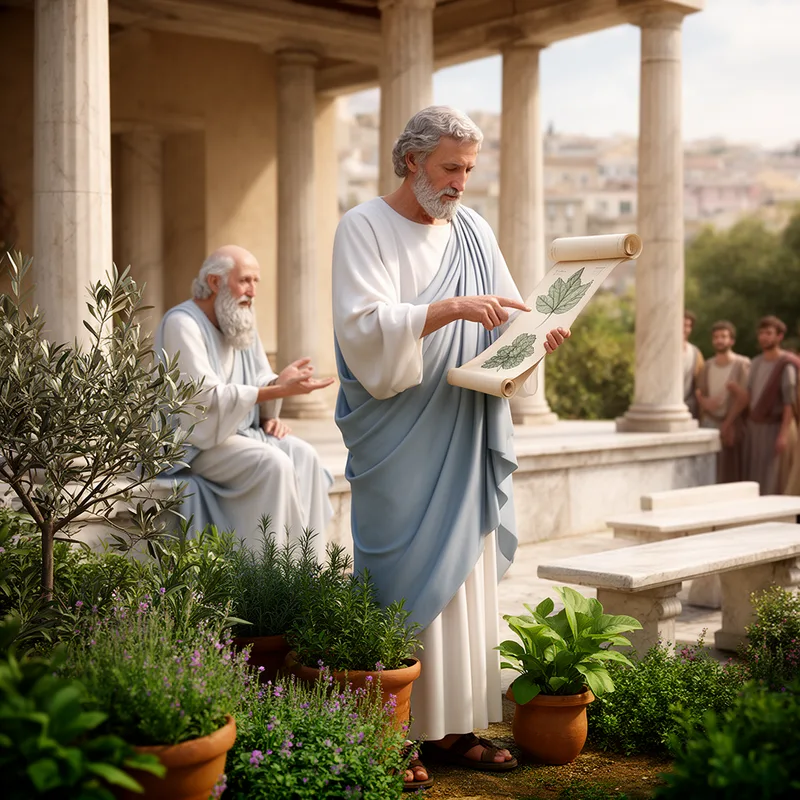
The Theophrastus, a prominent Greek philosopher, made significant contributions to botany and is often referred to as the 'father of botany.'
-
In his writings, Theophrastus detailed the characteristics of over 500 plant species, showcasing his extensive knowledge of natural history.
-
As a student of Aristotle, Theophrastus furthered the study of philosophy and science in ancient Greece.
Surface Forms
Etymology
Theophrastus is an old Greek name made from theo- meaning 'god' and phrasis meaning 'speech', like the English word phrase. So the name literally means 'divine speaker', which fits a philosopher and teacher who spoke and wrote about nature.