
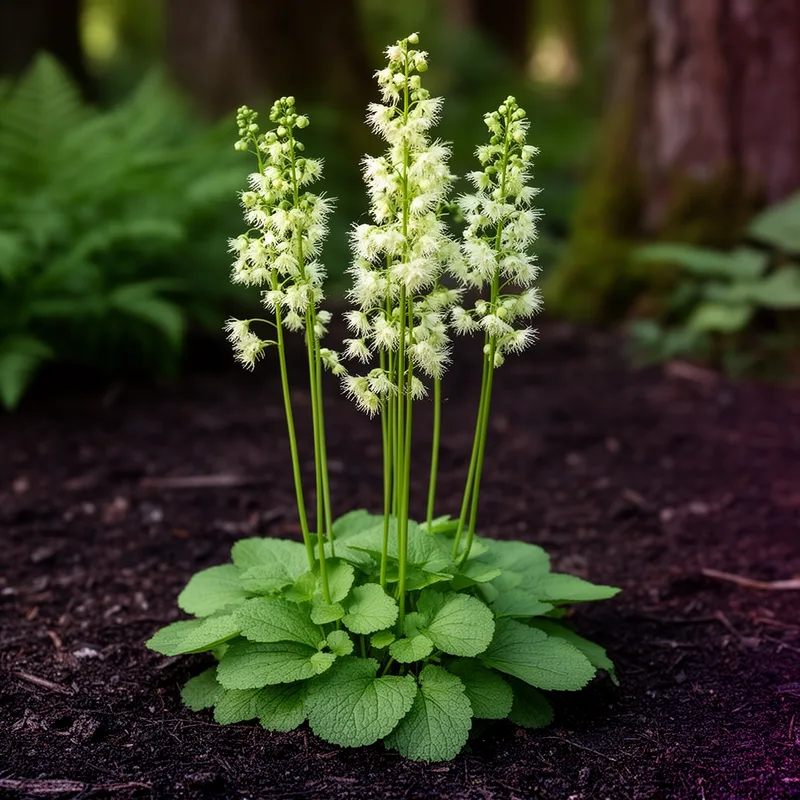
Tellima grandiflora
- noun
- Specialized
- Tellima grandiflora is a perennial plant known for its clumping growth and beautiful pale pink flowers in gardens.
Examples
-
The woodland trail was dotted with patches of Tellima grandiflora in bloom each spring.
-
Tellima grandiflora is often grown in shade gardens for its attractive foliage and delicate flower spikes.
-
Gardeners appreciate how Tellima grandiflora thrives in moist, well-drained soils.
-
The Tellima grandiflora blooms beautifully in the spring.
-
Have you seen the Tellima grandifloras at the botanical garden?
-
Many gardeners enjoy the elegant appearance of Tellima grandiflora as it adds charm to shaded areas.
-
In spring, Tellima grandiflora showcases long racemes of delicate, fringed flowers, brightening the woodland landscape.
Synonyms

A plant that lives many years in low leaf clumps with pale pink or cream fringed flowers in clusters

A plant from western North America with clumps of low leaves and pale fringed flowers on long stalks
Surface Forms
Morphology
This is a botanical binomial combining the genus name 'Tellima' with the Latin epithet 'grandiflora' (literally 'large-flowered'), so the overall meaning — a Tellima plant with large flowers — is directly derivable from the constituents. Scientific name patterns like genus + descriptive epithet are cross-linguistically regular, making the composition transparent to learners who know both parts.
Etymology
Tellima grandiflora is a scientific name: the first word Tellima is the group name used by scientists and the second word grandiflora comes from Latin and means 'large-flowered'. So the name is a simple memory hint — it tells you this clumping plant has noticeable, pale, fringe-like flowers.

