
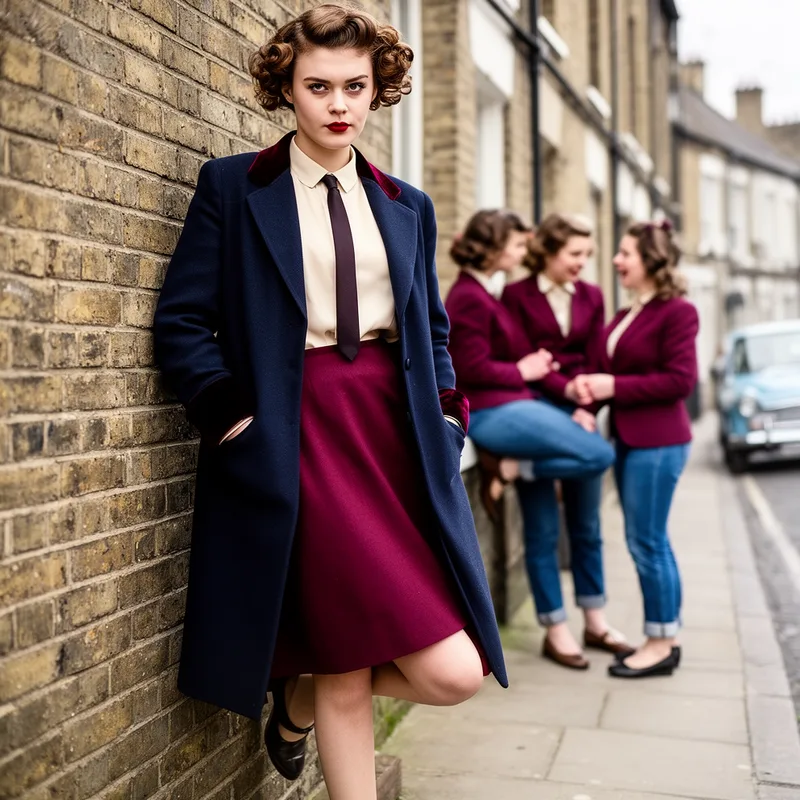
Teddy girl
- noun
- /ˈtɛdi ɡɜːl/
- Archaic
- The Teddy girl movement challenged traditional gender roles with its bold fashion and attitude.
Examples
-
As a teenager, she proudly dressed as a Teddy girl and frequented the local dance halls.
-
Photographs from the era show groups of Teddy girls gathered on London streets.
-
The Teddy girl wore a stylish Edwardian dress.
-
Many Teddy girls embraced bold hairstyles.
-
As a teenager, she proudly dressed as a Teddy girl and frequented the local dance halls.
-
Photographs from the era show groups of Teddy girls gathered on London streets.
-
The Teddy girl movement challenged traditional gender roles with its bold fashion and attitude.
Surface Forms
Morphology
Teddy + girl
The meaning 'a young woman of the 1950s/60s British Edwardian-inspired subculture' cannot be derived from the literal parts: 'girl' is transparent but 'Teddy' here is a culturally specific label (not a transparent lexical item) and does not signal Edwardian fashion. This is a historical/cultural term tied to a specific subculture and thus would be unpredictable to a B1 learner who only knows the constituent words.
Etymology
Teddy girl comes from 1950s Britain: Teddy is short for 'Edward', because these young women copied old Edwardian clothes. They dressed in that old-style fashion and showed a bold, rebellious attitude, so Teddy girl came to mean a young woman from that youth subculture.

