
Te Deum


 1
9.9
1
9.9
- noun
- /teɪ ˈdiːəm/
- Literature
- Te Deum was followed by the Lord's Prayer and then by specially composed prayers and hymns led by the Archbishop of Canterbury and the Bishop of London.
- sing the Te Deum
Examples
-
A Te Deum composed by Prince Albert was central to the Westminster Abbey jubilee service.
Academic text (1997) -
Afterwards, the Most Reverend Archbishop made it public by announcing it in the choir of Nidaros Cathedral, with the ringing of bells and the chanting of Te Deum.
Academic text (1998) -
A magnificent "Te Deum" is being sung in honor of Columbus' achievements and return.
Fiction book (1992) -
We start to hear the "Te Deum," majestic and heavenly.
Fiction book (1992) -
And in fact, the Grand Bell, named the Emmanuel Bell, which is tuned to F sharp, has been an accompaniment to a number of the foremost major events in the history of France ever since it was initially forged, such as the Te Deum for the coronation of French kings, in conjunction with major events like the visit of the Pope, and others to mark the end of conflicts, including World War I and World War II.
Blog text (34) -
INTERIOR MONTCALM'S MARQUEE - CHORAL GROUP - NIGHT of three Seneca women and five boys, led by a Jesuit, sing the Te Deum in the Iroquois language.
Fiction book (1992) -
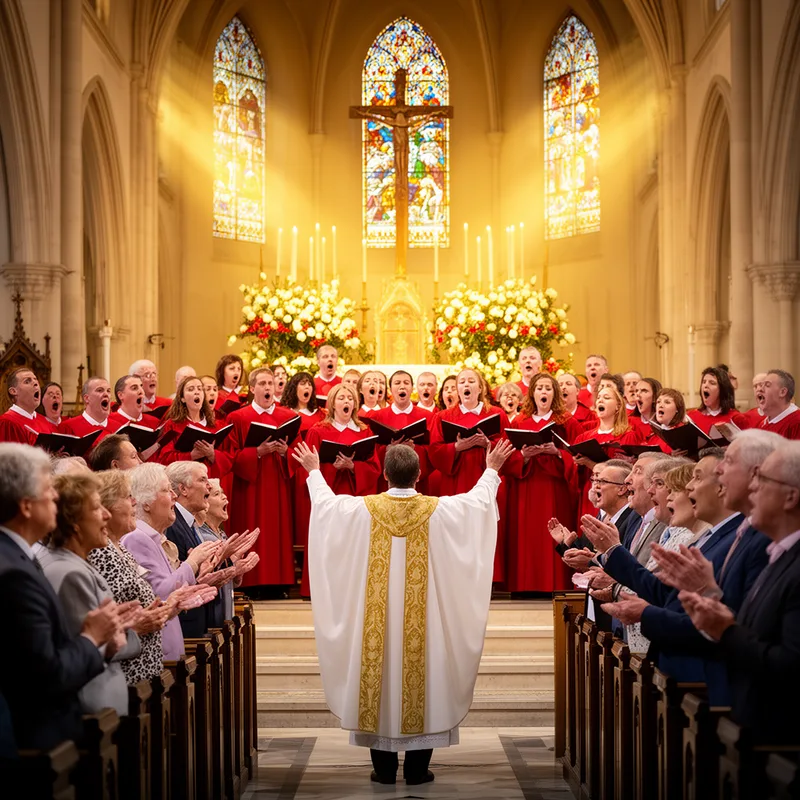
The choir performed the Te Deum at the special service to celebrate the anniversary of the church.
-
During the celebration, we joyfully sang the Te Deum to give thanks for the harvest.
-
At the end of the memorial, everyone joined in singing the Te Deum to honor those who had passed.
How Praiseful

Surface Forms
Morphology
Te + Deum
This is a fixed Latin title (a hymn) whose constituents are not English lexical items and are not listed in the provided dictionary entries, so an average B1 English learner cannot derive the meaning from the parts. The phrase functions as a proper name/title rather than a compositional English expression, making its meaning unpredictable without prior cultural or lexical knowledge.
Etymology
Te Deum takes its name from the old Latin words Te and Deum, which mean 'you' and 'God' and begin the line 'We praise you, O God.' It was used as a short song of thanks at important church events, so today Te Deum means that hymn of praise sung on special occasions.