

Tanacetum vulgare
- noun
- Specialized
- The garden was dotted with clusters of Tanacetum vulgare in full bloom.
Examples
-
We planted Tanacetum vulgare along the fence for its bright flowers and aromatic scent.
-
Traditional remedies sometimes included extracts from Tanacetum vulgare leaves.
-
The Tanacetum vulgare plant thrives in sunny areas.
-
Many herbalists recommend Tanacetum vulgare for its medicinal properties.
-
Traditional remedies sometimes included extracts from Tanacetum vulgare leaves.
-
Many herbalists recommend Tanacetum vulgare for its medicinal properties.
-
We planted Tanacetum vulgare along the fence for its bright flowers and aromatic scent.
Synonyms

 1
9.3
1
9.3

A common herb with small yellow button flowers and bitter leaves used to keep insects away

A small plant with round yellow flowers and a strong smell used as a medicine
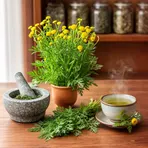
A small herb with yellow button flowers and bitter leaves used in traditional medicine
Surface Forms
Morphology
Tanacetum + vulgare
This is a taxonomic binomial composed of the genus name Tanacetum (a group of flowering plants) and the Latin epithet vulgare (meaning 'common'); if a learner knows both constituents they can infer it denotes the common species of that genus (common tansy). Scientific Latin names are compositional and used consistently across languages, so the meaning here is derivable rather than idiomatic.
Etymology
Tanacetum vulgare may get its name from an old word meaning 'everlasting' because people used the plant in medicines and funeral wreaths. That's why the name fits this hardy, long-lived herb with bitter leaves and bright yellow flowers.