
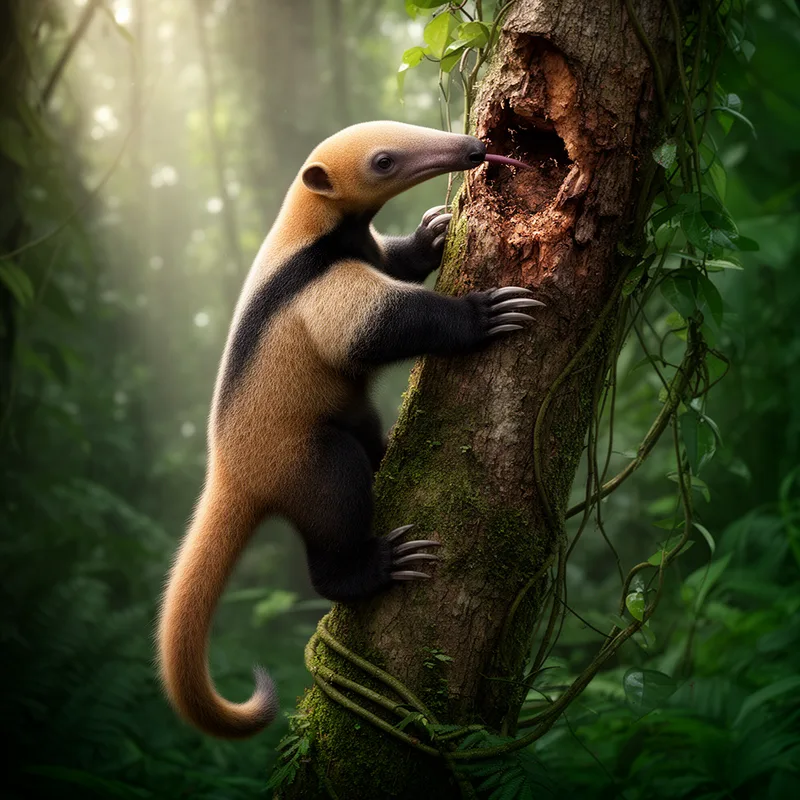
Tamandua tetradactyla
- noun
- /ˌtæmənˈduːə ˌtɛtrəˈdæktɪlə/
- Specialized
- Unlike the giant anteater, the Tamandua tetradactyla is much smaller and more arboreal.
Examples
-
Researchers observed a Tamandua tetradactyla climbing trees using its prehensile tail for balance.
-
The Tamandua tetradactyla uses its long tongue to extract ants from nests in the rainforest.
-
The Tamandua tetradactyla is known for its unique prehensile tail.
-
Have you ever seen a Tamandua tetradactyla in the wild?
-
Researchers observed a Tamandua tetradactyla climbing trees using its prehensile tail for balance.
-
The Tamandua tetradactyla uses its long tongue to extract ants from nests in the rainforest.
-
Unlike the giant anteater, the Tamandua tetradactyla is much smaller and more arboreal.
Synonyms
A small anteater from Central and South America with a long grasping tail and strong claws that eats insects
Surface Forms
Morphology
tamandua + tetradactyla
This is a Latin binomial where the first element 'tamandua' names the animal and the second element is a classical compound meaning 'four-toed' (tetra-/dactyl-). The overall meaning ('a tamandua with four digits') is compositional in principle, but the technical Latin/Greek morphology is specialized and not reliably known by a B1 learner, so the transparency is partial.
Etymology
Tamandua tetradactyla is the name of a small tree-climbing anteater; Tamandua is the anteater name and tetradactyla means 'four toes'. Imagine a small anteater with a long tongue, a tail that can hold branches, and four strong front claws, and you see why the name fits this climbing anteater.

