
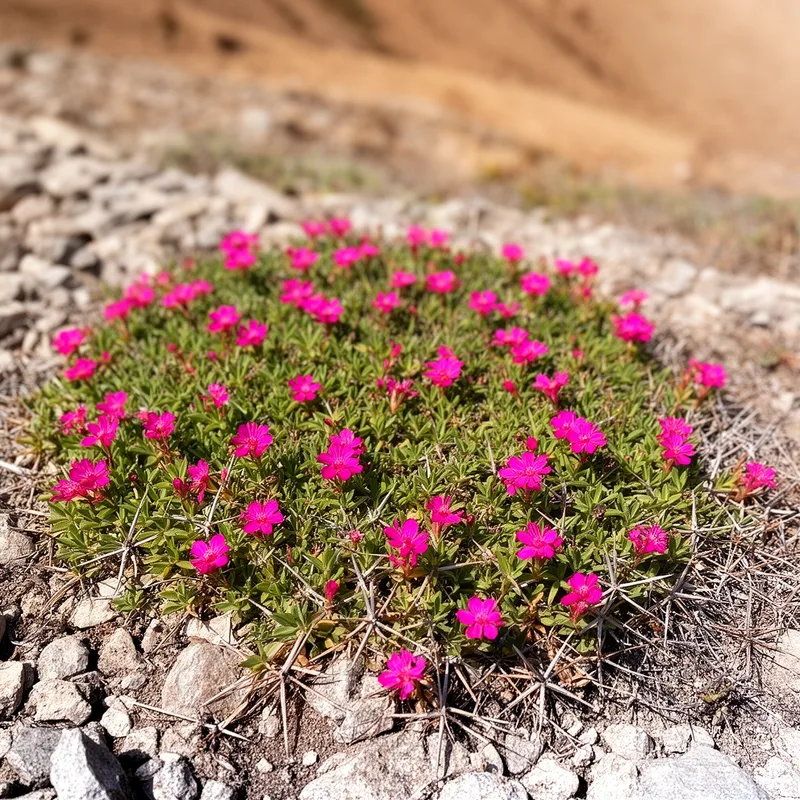
Talinum spinescens
- noun
- Specialized
- In the arid hills, Talinum spinescens is known for its vibrant crimson-magenta flowers and distinctive spiny leaf midribs.
Examples
-
In the arid hills, Talinum spinescens is easily recognized by its spiny leaf midribs that remain after leaves fall.
-
Gardeners value Talinum spinescens for its resilience in dry, rocky soils.
-
Botanists surveyed an area populated by Talinum spinescens, noting its vivid magenta flowers.
-
The Talinum spinescens blooms beautifully in the desert.
-
Have you seen a Talinum spinescens in bloom?
-
Gardeners appreciate Talinum spinescens for its ability to thrive in dry, rocky environments with minimal care.
-
Botanists often study Talinum spinescens because it adapts well to the challenges of southwestern U.S. climates.
Synonyms

A low cushion plant with pink flowers and leaf middle veins that stay as spines
Surface Forms
Morphology
Talinum + spinescens
This is partially transparent because the Latin epithet 'spinescens' is morphologically related to 'spine' and thus signals a spiny characteristic, so a learner familiar with Latin-derived morphemes might infer that feature. However, the genus name is a proper taxonomic label and the full descriptive meaning (a low, cushion-forming desert plant with rose to magenta flowers and spiny midribs) is not recoverable from the parts alone for an average B1 learner, so the expression is only partially predictable.
Etymology
Talinum spinescens gets its name from the plant's look: spinescens means 'becoming spiny'. This low cushion plant has the middle of each leaf turn into a small spine when the leaf dies, so the name helps you remember its spiny parts.

