
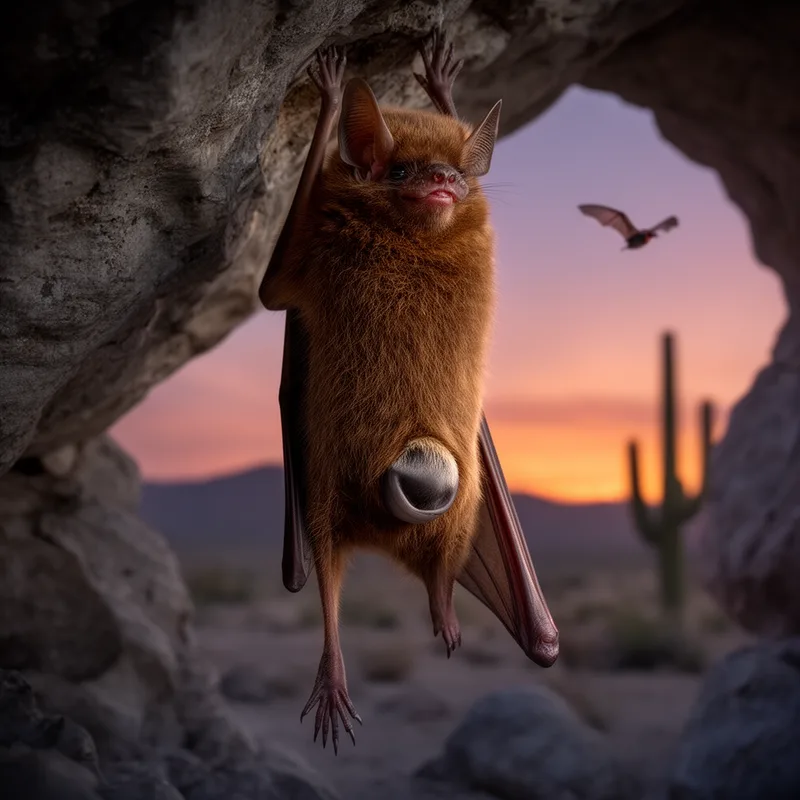
Tadarida femorosacca
- noun
- Specialized
- The Tadarida femorosacca can often be seen flying at dusk in southern California.
Examples
-
Unlike other bats, Tadarida femorosacca is noted for the distinctive pocket near its thigh.
-
Researchers studied the roosting behavior of Tadarida femorosacca in arid habitats.
-
The Tadarida femorosacca is known for its unique appearance.
-
Have you ever seen a Tadarida femorosacca in the wild?
-
The Tadarida femorosacca uses its unique pocket to store food while foraging at night.
-
During field studies, scientists observed Tadarida femorosacca roosting in large colonies under bridges.
-
In the evening, the Tadarida femorosacca emerges to catch insects, showcasing its agile flying skills.
Synonyms

A small brown bat that lives in California and northern Mexico
A small brown bat from California and northern Mexico with pockets near its tail
Surface Forms
Morphology
Tadarida + femorosacca
This is a Latin binomial (genus + species epithet) used as a scientific name rather than an English compositional phrase. Even if a learner knows 'Tadarida' as a bat genus, 'femorosacca' is not an English word and its Latin roots would not be transparent to a B1 learner, so the overall meaning (‘a particular species of bat’) cannot be derived from the constituents.
Etymology
Tadarida femorosacca gets its name from old Latin words: the second part, femoro and sacca, mean 'thigh' and 'pocket' because this bat has a small pocket near its thigh. So the name points to the bat's unusual 'pocketed thigh'.

