
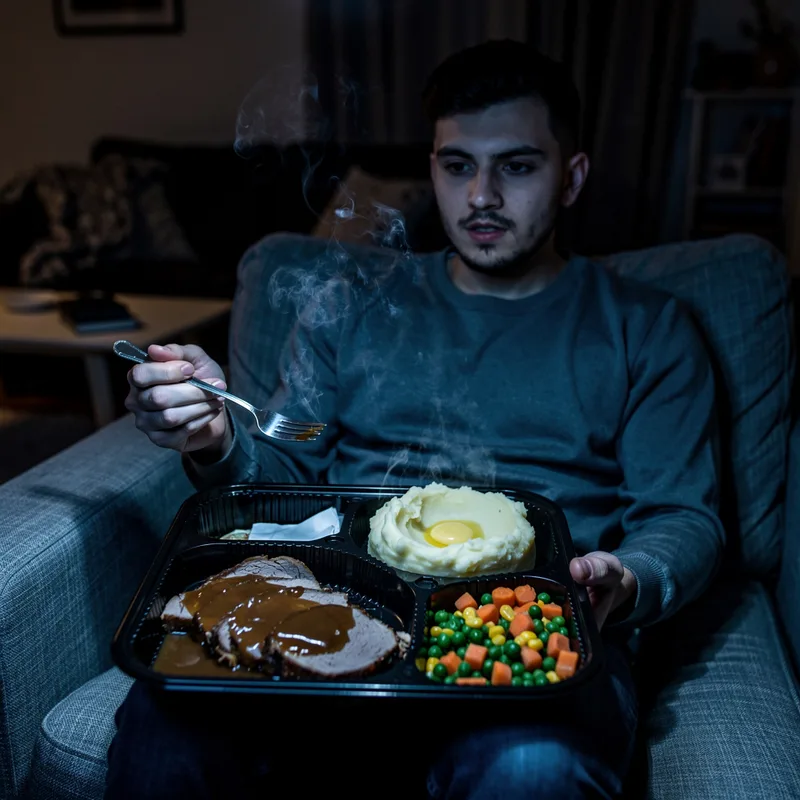
TV dinner
 19
2.8
19
2.8

- noun
- /ˈtiːˈviː ˈdɪnər/
- US
- In the freezer, there's a TV dinner.
- eat TV dinners
- frozen TV dinner
- heat up a TV dinner
Loading YouTube…
Watch on YouTubeThat has obviously evolved, you know, from TV dinners to maximum convenience to like, I still don't take a lunch break.
- That has obviously evolved, you know, from TV dinners to maximum convenience to like, I still don't take a lunch break.
Examples
-
He put the TV dinner in the microwave for a quick meal while watching his favorite show.
-
Peter's eating a TV dinner, alone.
Fiction book (1999) -
It's called a TV dinner.
-
- I used to get that turkey TV dinner.
-
I'll just eat a TV dinner here and watch football.
Fiction book (1991) -
I'm just eating a TV dinner.
-
I'll leave a TV dinner in the fridge.
-
For the first few years of our married life, we ate a lot of TV dinners with lots and lots of pudding.
Fiction book (2001) -
Remember when TV dinners were the norm and Swanson's became a household name?
Blog text (29) -
Early in the book, we find the parents passively eating TV dinners from aluminum receptacles and enjoying an evening of mindless viewing.
Academic text (1992)
How Convenient
- US
19
2.8
 4
1.3
4
1.3
Surface Forms
Morphology
The compound 'TV dinner' transparently combines 'TV' (television) and 'dinner' to indicate a meal associated with television — a learner can infer it is a meal eaten while watching TV. However, the conventionalized sense of a prepackaged, frozen meal intended to be quickly heated is a cultural/commercial extension that is not fully predictable from the constituents alone. Because the basic association is clear but the specific packaged-product meaning requires prior exposure, it is best classified as semi-transparent.
Etymology
TV dinner comes from the 1950s, when companies sold frozen meals in trays meant to be heated and eaten in front of the television. The words TV and dinner give the picture: a ready-made 'dinner' for the 'TV', so today the phrase means 'a frozen prepackaged meal you heat and eat', often while watching TV.