
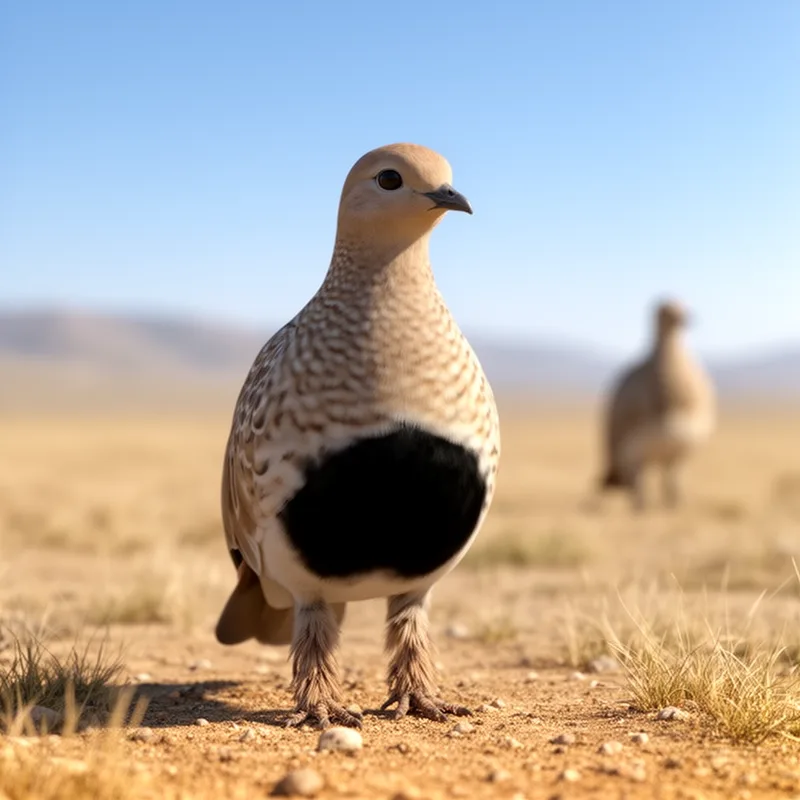
Syrrhaptes paradoxus
- noun
- Specialized
- The distinctive black belly patch helps researchers quickly identify Syrrhaptes paradoxus in the field.
Examples
-
The sudden arrival of hundreds of Syrrhaptes paradoxus in Britain caused a sensation among birdwatchers.
-
Wildlife photographers traveled to Mongolia to capture images of the elusive Syrrhaptes paradoxus.
-
Look at that Syrrhaptes paradoxus!
-
The Syrrhaptes paradoxus is known for its unique plumage.
-
The distinctive black belly patch helps researchers quickly identify Syrrhaptes paradoxus in the field.
-
The sudden arrival of hundreds of Syrrhaptes paradoxus in Britain caused a sensation among birdwatchers.
-
Wildlife photographers traveled to Mongolia to capture images of the elusive Syrrhaptes paradoxus.
Synonyms

A bird that lives in dry areas of Europe and Asia with a black patch on its belly
Surface Forms
Morphology
Syrrhaptes + paradoxus
This is a Latin binomial (a scientific species name) that functions as an arbitrary proper noun; knowing the genus label 'Syrrhaptes' and an untranslated/unknown epithet 'paradoxus' does not let a B1 learner infer the specific sense 'a Eurasian sandgrouse with a black belly patch'. Scientific names are not compositionally meaningful in ordinary vocabulary terms and are therefore not transparent across languages or to learners without prior exposure.
Etymology
Syrrhaptes paradoxus may come from Greek words: Syrrhaptes meaning 'sewn together', which refers to the bird's feathered, joined toes, and paradoxus meaning 'strange' or 'unexpected'. So the name fits this sandgrouse today because it has unusual joined toes and a surprising black belly patch.

