
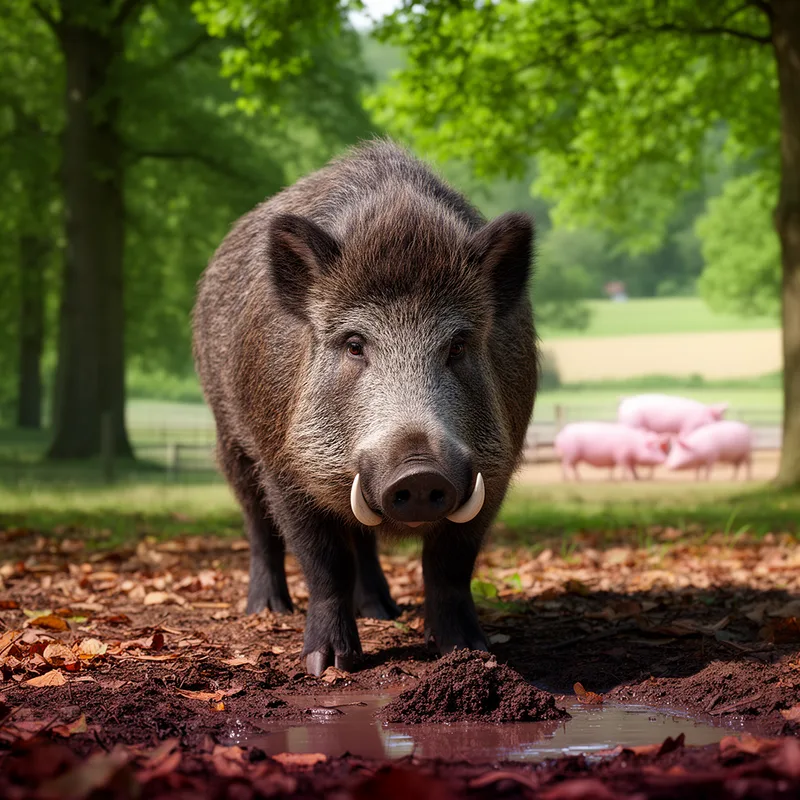
Sus scrofa
- noun
- Specialized
- In many regions, Sus scrofa populations have expanded due to reduced hunting.
Examples
-
The Sus scrofa is known for its adaptability in various habitats.
-
Genetic studies show that most domestic pigs are descended from Sus scrofa.
-
The European Sus scrofa is native to forests across Eurasia.
-
In many regions, Sus scrofa populations are increasing rapidly.
-
The Sus scrofa, commonly known as wild boar, is often found in forests and grasslands across Europe.
-
Conservationists are studying the behavior of Sus scrofa to better understand its role in the ecosystem.
-
In many regions, Sus scrofa is considered a game animal and is hunted for sport and food.
Synonyms
 24
2.9
24
2.9

A wild pig with tusks that lives in forests and is the ancestor of most farm pigs
 9
3.4
9
3.4
A large wild pig that lives in forests and has long tusks
Surface Forms
Morphology
Sus + scrofa
This is a Latin binomial (taxonomic) name rather than a compositional English phrase; B1 learners who know ordinary English words will not reliably infer ‘wild boar’ from the parts because species epithets are Latin and require specialist/taxonomic knowledge. The second element 'scrofa' is not an English word (undefined here), and 'Sus' functions as a genus label rather than a meaningful everyday lexical item, so the meaning is not derivable from the constituents.
Etymology
Sus scrofa is a name from old Latin words: Sus means 'pig' and scrofa means 'female pig'. It was used for the wild pig found in forests and today names the wild boar that is the ancestor of domestic pigs, so the name points to a wild pig species.