
Sturnella neglecta
- noun
- Specialized
 :
Sturnella neglecta
:
Sturnella neglecta
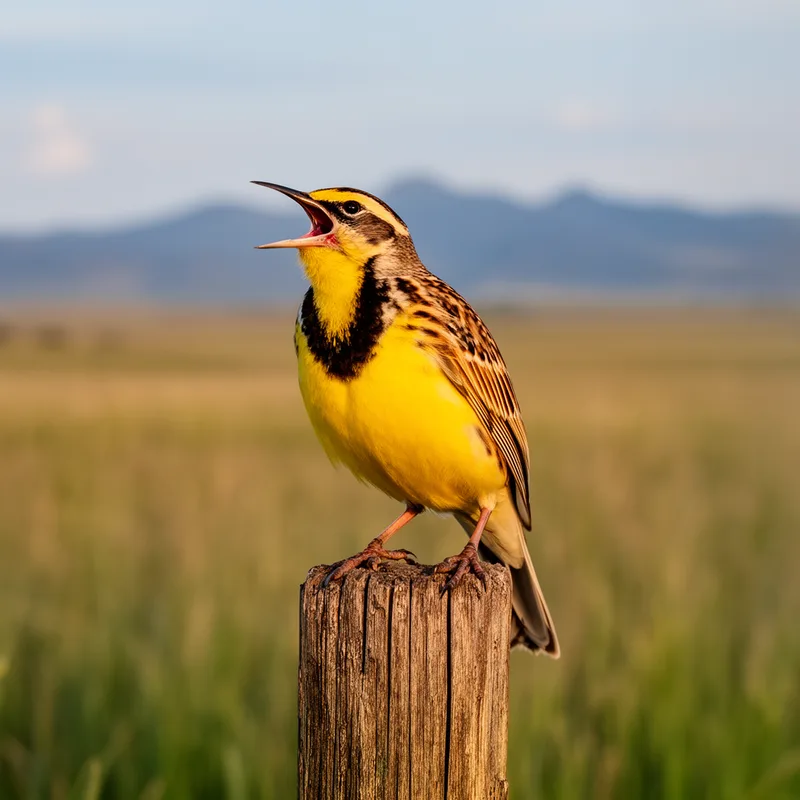
- The bright yellow underparts of the Sturnella neglecta make it easy to identify in the wild.
Examples
-
The song of the Sturnella neglecta is often heard across the grasslands in spring.
-
The Sturnella neglecta is often found in open grasslands.
-
I spotted a Sturnella neglecta singing from a fence post during my trip to Colorado.
-
Researchers studied the migration patterns of Sturnella neglecta throughout the western United States.
-
I saw a Sturnella neglecta singing beautifully in the park.
-
While hiking in the mountains, I heard the beautiful song of a Sturnella neglecta nearby.
-
During the spring, many Sturnella neglecta return to their nesting grounds in the grasslands.
Synonyms

 3
7.4
3
7.4

A North American bird with a yellow chest that sings sweetly

A medium-sized bird with a bright yellow chest that sings in open grasslands
Surface Forms
Morphology
Sturnella + neglecta
This is a scientific binomial: a learner who knows 'Sturnella' (a genus of meadowlarks) can infer that the phrase names a kind of meadowlark, but 'neglecta' is a Latin species epithet (not a standard English word) and does not convey clear, predictable meaning to a B1 learner. The construction therefore gives partial information (taxonomic relation) but the specific sense of the epithet is not derivable without specialist or Latin knowledge, making it only partially transparent.
Etymology
Sturnella neglecta is a scientific name from Latin words: Sturnella is a name for a small bird and neglecta means 'neglected' or 'overlooked' because this meadowlark was long confused with another species. So the name helps you remember that this yellow, singing bird was once missed by scientists and later recognised as its own species.