
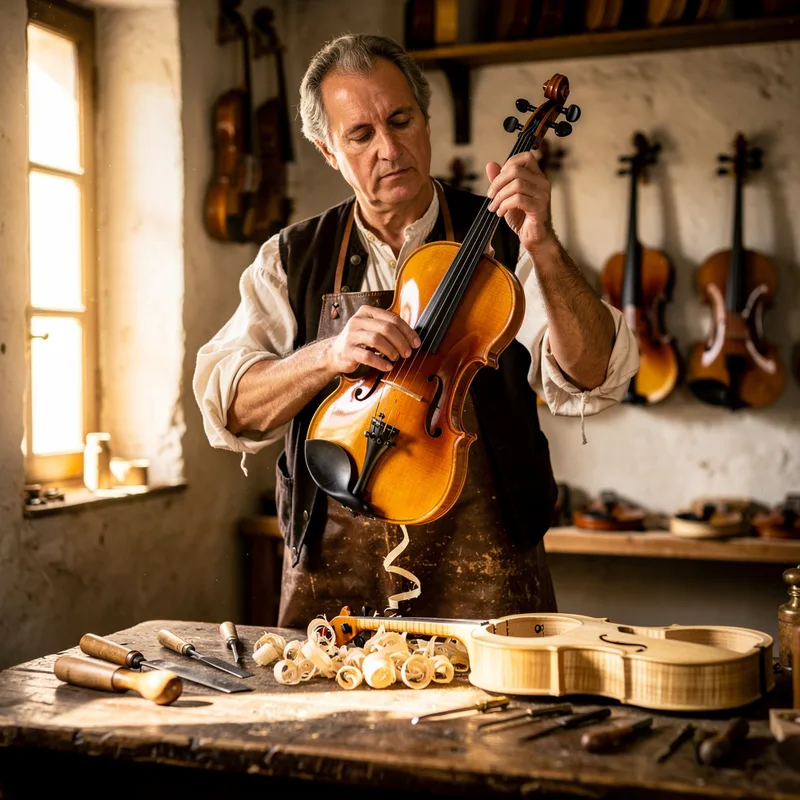
Stradivari
 2
9.3

- proper noun
- /strædəˈvɛri/
- If that note emerges from a Stradivari cello, it will have a distinct, identifiable set of characteristics.
- Stradivari cello
- Stradivari instruments
- Stradivari violin
Examples
-
In the 1690s, though, Stradivari embarked on a rapid series of experiments.
Academic text (1994) -
The question remains: How did Stradivari and his contemporaries get that sound?
Academic text (1994) -
Stradivari's instruments possess this quality of complexity, of personality, in the highest degree.
Academic text (1994) -
The answer to the first part of that question—what Stradivari did as he made his instruments—is actually well known.
Academic text (1994) -
Even the decorative scrolls, Sacconi argued, revealed Stradivari's deep, systematic knowledge of his craft.
Academic text (1994) -
Bach's omnivorous musical interests extended to the labor of instrument design and construction that was Stradivari's lifework.
Academic text (1994) -
Several great violinists, including Paganini and currently Isaac Stern, have preferred his instruments to Stradivari's.
Academic text (1994) -
Several makers have tried to build Stradivari-like instruments by recreating back and belly tunings observed on various Stradivari violins.
Academic text (1994) -
Antonio Stradivari is famous for creating some of the best violins in history.
-
Many musicians dream of playing a cello made by Stradivari due to its unmatched quality.
Synonyms
 1
9.0
An Italian violin maker who developed the modern violin and made instruments with very good sound
An Italian maker of violins famous for their very rich sound
Surface Forms
Etymology
Stradivari is the family name of Antonio Stradivari, a famous Italian violin maker from Cremona, and it is used to name the special violins he made. You may also see the Latin form Stradivarius, which works like a 'brand name' for those top-quality violins, so a Stradivari means a violin made by that master.