
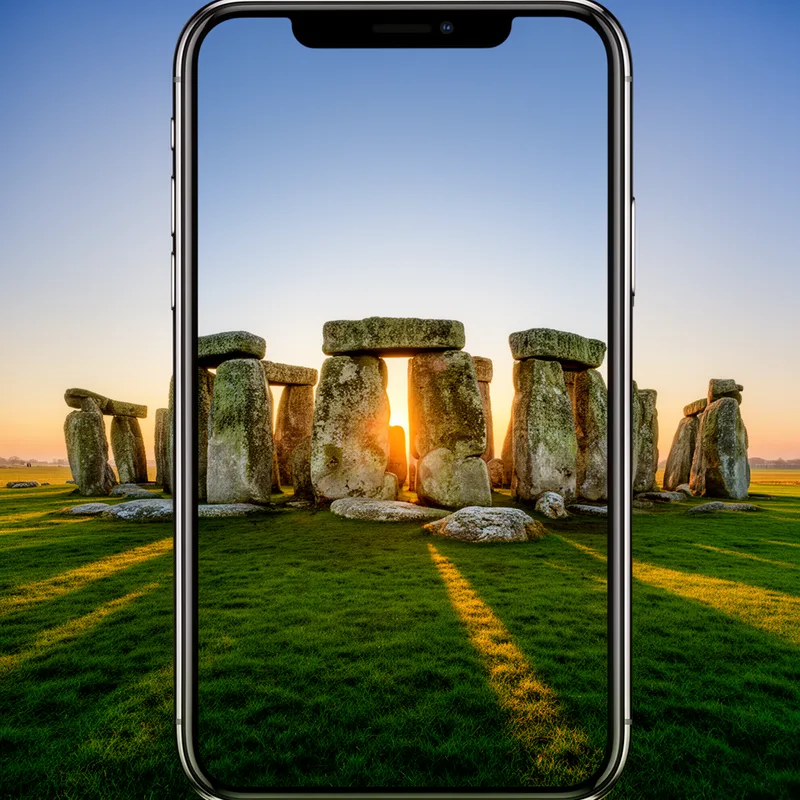
Stonehenge
 15
5.3

- proper noun
- /ˈstoʊnˌhɛndʒ/
- The avenue begins at Stonehenge with a straight section aligned with the site's solar axis.
- Stonehenge Avenue
- Stonehenge excavations
- site of Stonehenge
Loading YouTube…
Watch on YouTubeAnd they call the center of Stonehenge a cell, and it's called the altar stone.
- And they call the center of Stonehenge a cell, and it's called the altar stone.
- We would just we'd went to Stonehenge and she was not feeling well.
- Yeah, what they, what they refer to as, you know, the like Stonehenge and stuff, they're mystery.
- Oh guys, I appreciate the cause but what did Stonehenge ever do?
- You know, what else is interesting is all of these wonders of the world, The pyramid, Stonehenge, Machu Picchu is a Easter Island.
Examples
-
I'm here at Stonehenge for what has been an interesting unfolding of events today.
-
And they call the center of Stonehenge a cell, and it's called the altar stone.
-
Clark, do you think we'll have time to see Stonehenge?
-
Ideas about why Stonehenge was built need to account for Neolithic politics.
Academic text (2008) -
And for centuries, historians have puzzled over the purpose of Stonehenge.
-
Among the hundreds, if not thousands, of ancient sites British pagans hold sacred, Stonehenge occupies a special place.
Academic text (2003) -
Mike Pitts, the editor of British Archaeology, has also directed excavations at Stonehenge.
Academic text (2010) -
During last June's summer solstice, I joined the crowd at Stonehenge, estimated to be 24,000.
Academic text (2008) -
For Britain's modern-day pagans, sites like Stonehenge are sacred ground.
Academic text (2003) -
Stonehenge is an ancient stone circle monument in southern England, known for its ceremonial significance.
Synonyms


 1
9.2
A monument of very large stones that dates from long ago
 1
9.9
A round ancient place with a bank and ditch that often has standing stones
Surface Forms
Morphology
Etymology
Stonehenge comes from old English parts stān 'stone' and hencg 'hinge' or 'hang'. A helpful way to remember it is to think of 'hanging' or 'linked' stones, which fits because Stonehenge is a circle of large stones that seem joined together.