
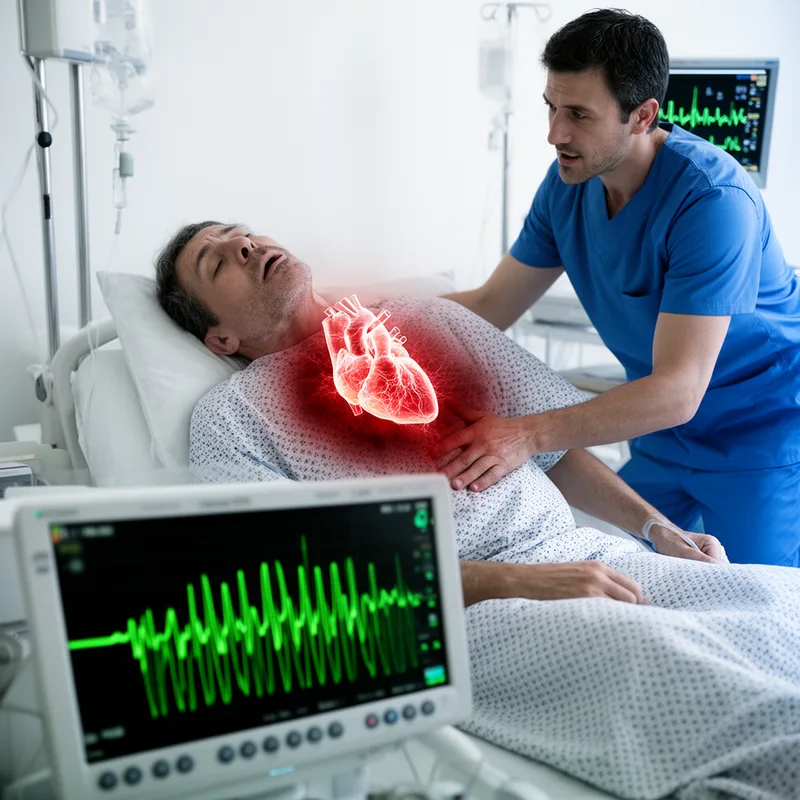
Stokes-Adams syndrome
- noun
- /ˈstoʊks ˈædəmz ˈsɪndroʊm/
- Specialized
- The patient was diagnosed with Stokes-Adams syndrome after experiencing brief losses of consciousness.
Examples
-
Treatment for Stokes-Adams syndrome often involves the implantation of a pacemaker.
-
Patients with Stokes-Adams syndrome often experience fainting spells.
-
Doctors monitored his heart rhythm closely following an episode of Stokes-Adams syndrome.
-
The doctor diagnosed her with Stokes-Adams syndrome.
-
The patient was diagnosed with Stokes-Adams syndrome after experiencing brief losses of consciousness.
-
Doctors monitored his heart rhythm closely following an episode of Stokes-Adams syndrome.
-
Patients with Stokes-Adams syndrome often experience fainting spells.
Synonyms
The heart's electrical signals stop briefly and cause sudden repeated fainting
Surface Forms
Morphology
Stokes-Adams + syndrome
This is an eponymic medical term: 'Stokes‑Adams' is a proper name with no lexical meaning while 'syndrome' only signals a set of symptoms, so a B1 learner who knows the parts could not infer the specific condition (recurrent sudden unconsciousness due to cardiac conduction failure). Because the label is technical and non-compositional, its precise medical meaning is not derivable from its constituents.
Etymology
Stokes-Adams syndrome is named after two 19th-century doctors, Stokes and Adams, who described patients who suddenly fainted when the heart's electrical signal failed. So the name now refers to those sudden 'fainting' or 'loss of consciousness' episodes caused by a problem with the heartbeat.

