
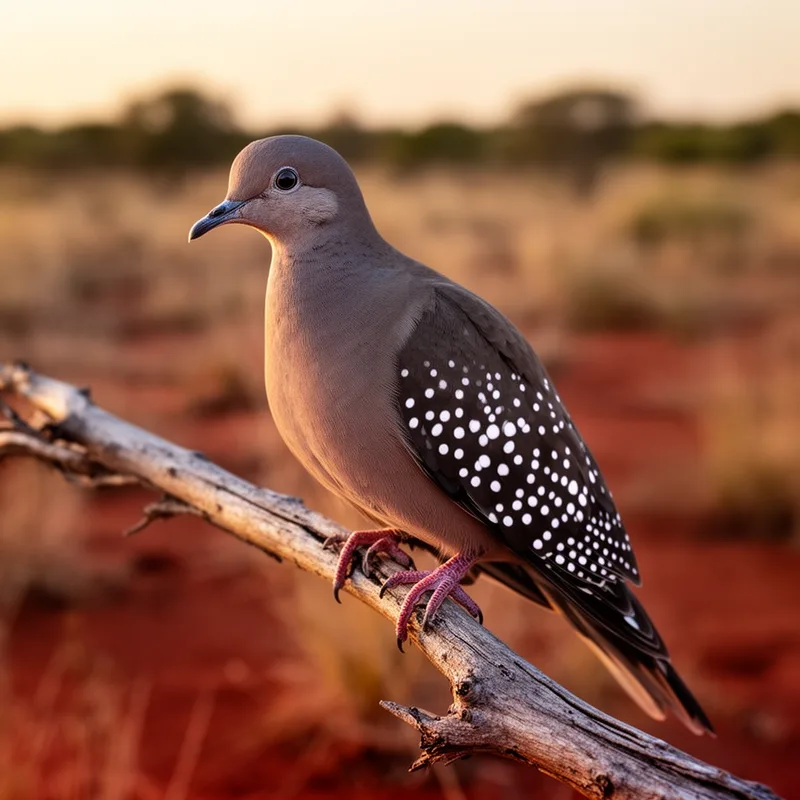
Stictopelia cuneata
- noun
- Australian
- Birdwatchers often travel to Australia to observe the elusive Stictopelia cuneata in its natural habitat.
Examples
-
The Stictopelia cuneata is admired for the white spots on its wings.
-
The gentle calls of the Stictopelia cuneata can be heard at dawn in the outback.
-
The Stictopelia cuneata is often seen in the bushland.
-
Have you ever spotted a Stictopelia cuneata in the wild?
-
Birdwatchers often travel to Australia to observe the elusive Stictopelia cuneata in its natural habitat.
-
The gentle calls of the Stictopelia cuneata can be heard at dawn in the outback.
-
The Stictopelia cuneata is admired for the white spots on its wings.
Surface Forms
Morphology
Stictopelia + cuneata
The binomial combines a bird genus name ('Stictopelia') with a Latin species epithet; a learner who knows the genus can infer it refers to a type of bird but will not derive the precise common name or range. The species epithet 'cuneata' is not lexically transparent to a B1 learner and scientific names function as conventional labels, so the exact meaning is only partly inferable from the constituents.
Etymology
Stictopelia cuneata may come from older Greek and Latin words: Stictopelia from words meaning 'spotted' and 'dove', and cuneata meaning 'wedge-shaped'. The name fits the small Australian diamond dove, with white spots on its wings and a slim, wedge-like tail, so the name describes the bird's look.

