
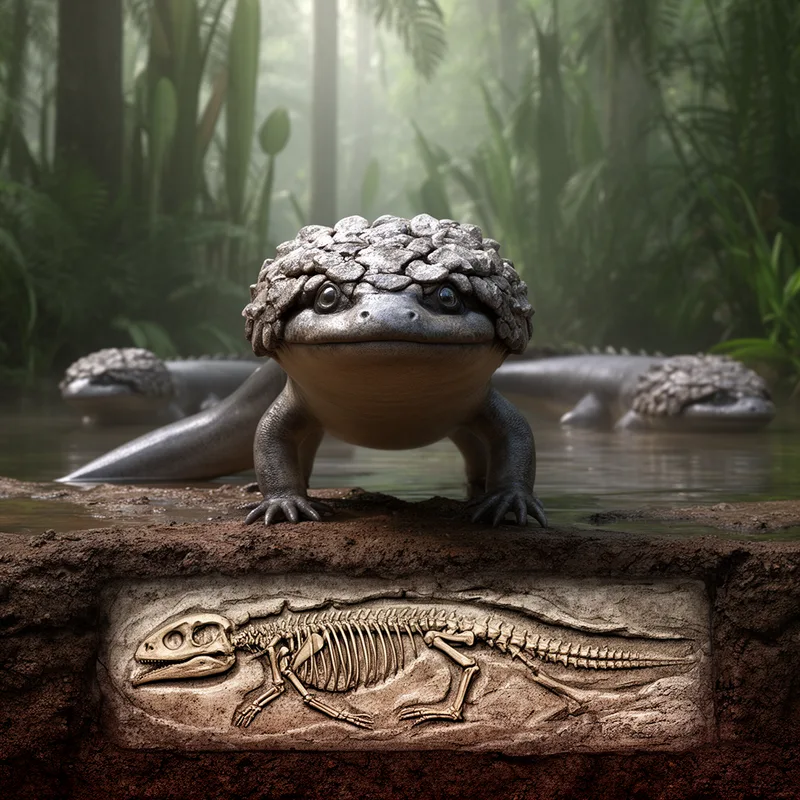
Stegocephalia
- noun
- /ˌstɛɡoʊˈsɛfəliə/
- Archaic
- Some paleontologists use the term Stegocephalia to group primitive amphibians with heavily armored skulls.
Examples
-
The classification of Stegocephalia has changed as paleontologists learn more about amphibian evolution.
-
Many fossils of Stegocephalia have been discovered in early Carboniferous rock formations.
-
The Stegocephalia were remarkable creatures of the past.
-
Many fossils of Stegocephalia have been discovered in North America.
-
Many fossils of Stegocephalia have been discovered in early Carboniferous rock formations.
-
Some paleontologists use the term Stegocephalia to group primitive amphibians with heavily armored skulls.
-
The classification of Stegocephalia has changed as paleontologists learn more about amphibian evolution.
Synonyms
A group of ancient amphibians with large bodies and bony skulls that lived before the Jurassic
Compounds
- Archaic
A group of ancient amphibians with large bodies and bony skulls that lived before the Jurassic
Surface Forms
Morphology
Stegocephalia = stego + cephal + ia
A technical taxonomic formation from Greek combining forms and the collective suffix '-ia' that is unlikely to be transparently understood by an average B1 learner.
Etymology
Stegocephalia comes from Greek parts stego- meaning 'cover' or 'roof' and -cephalia meaning 'head'. So it means 'covered head', which helps you remember these extinct amphibians had heavily armored skulls.

