
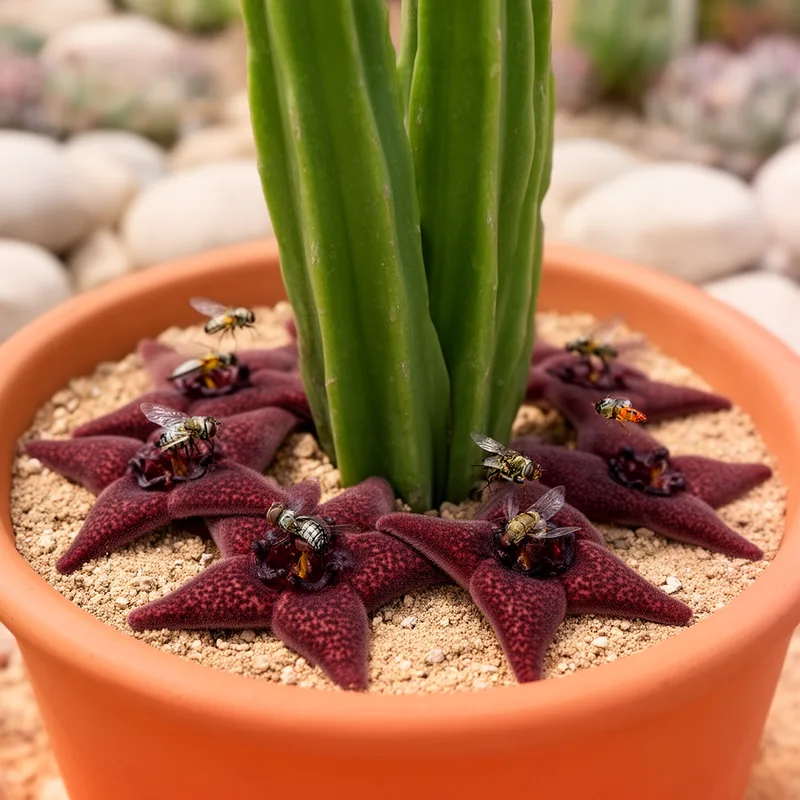
Stapelias asterias
- noun
- Specialized
- The distinctive flowers of Stapelias asterias are mostly dark red-brown and have flat, star-shaped corollas.
Examples
-
The distinctive flowers of Stapelias asterias make it a unique addition to succulent collections.
-
In its native habitat, Stapelias asterias attracts insects with its unusual scent.
-
Stapelias asterias thrives in well-drained, sandy soil and warm climates.
-
The Stapelias asterias blooms beautifully in the summer.
-
Many gardeners admire Stapelias asterias for its unique flowers.
-
Many gardeners cultivate Stapelias asterias because its unique flowers attract numerous pollinators.
-
In warm climates, Stapelias asterias flourishes and adds a striking appearance to succulent gardens.
Surface Forms
Morphology
Stapelia + asterias
This is a Latin binomial (a scientific name) where the genus 'Stapelia' may be recognizable as a plant group but the species epithet 'asterias' is a Latin/Greek form not known to a B1 learner. Scientific names act as proper nouns and require specialized botanical or classical-language knowledge, so the species meaning cannot be derived from the surface constituents by an average B1 learner.
Etymology
Stapelias asterias gives a simple picture of the plant. The first part, Stapelias, is the group name for this kind of succulent, and the second part, asterias, comes from a word for 'star' because the flat, star-shaped flowers look like stars, so the name helps you remember the flower's shape.

