
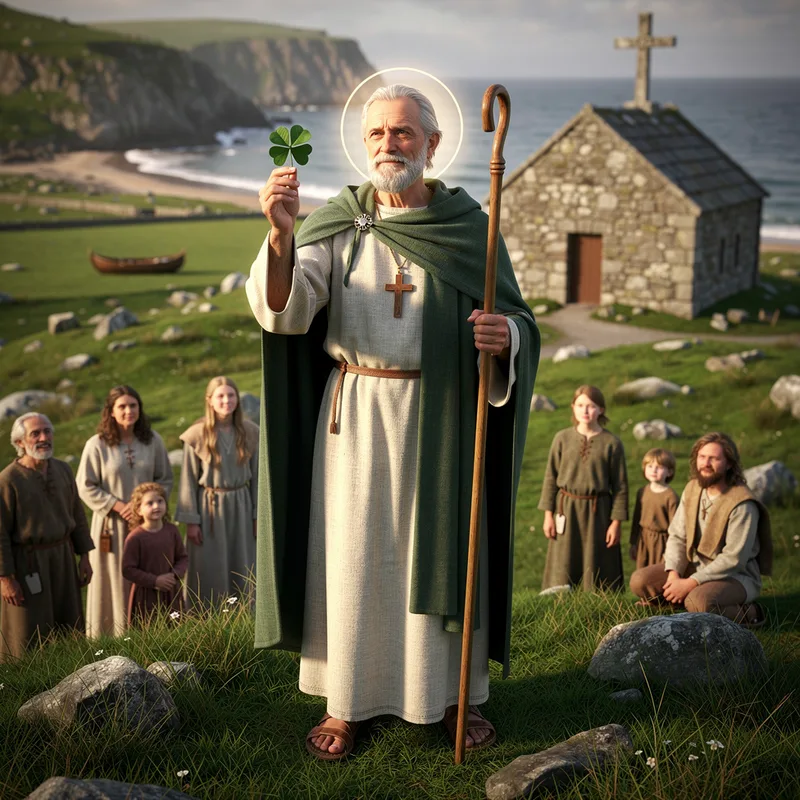
St. Patrick
 29
3.5

- proper noun
- /seɪnt ˈpætrɪk/
- Devotees often attend mass on St. Patrick's Day to honor the saint's contribution to Christianity in Ireland.
- St. Patrick's Day
- St. Patrick's Parade
- St. Patrick's Cathedral
Examples
-
Jackfish took May Anna to the St. Patrick's Day parade.
Fiction book (1990) -
On St. Patrick's Day, everybody in Butte is Irish.
Fiction book (1990) -
In Butte, we celebrated St. Patrick's Day for about a week because that's how long it took to do all the singing, dancing, and drinking.
Fiction book (1990) -
Every year, thousands of people celebrate St. Patrick's Day by wearing green and attending parades.
-
In Ireland, many traditions and customs are associated with St. Patrick, who is celebrated as a national hero.
Synonyms
 44
2.8
A 5th-century man known for bringing Christianity to Ireland and becoming the country's patron saint
 9
3.9
A Christian missionary from the 400s who brought Christianity to Ireland and became its patron saint
Surface Forms
Morphology
St. + Patrick
The form is compositionally clear: 'St.' (Saint) + 'Patrick' signals a saint called Patrick, so a B1 learner who knows the constituents will infer it refers to a person named Patrick who is a saint. However, the specific historical and cultural meaning (patron saint of Ireland, 5th‑century missionary) is world‑knowledge that cannot be derived from the words alone, so full understanding requires prior exposure.
Etymology
St. Patrick was a church teacher long ago who, one popular story says, used a three-leaf shamrock to show how the Father, Son and Holy Spirit are one. That's why he is remembered as the 'patron saint' of Ireland and why people celebrate 'St. Patrick's Day' every year.