
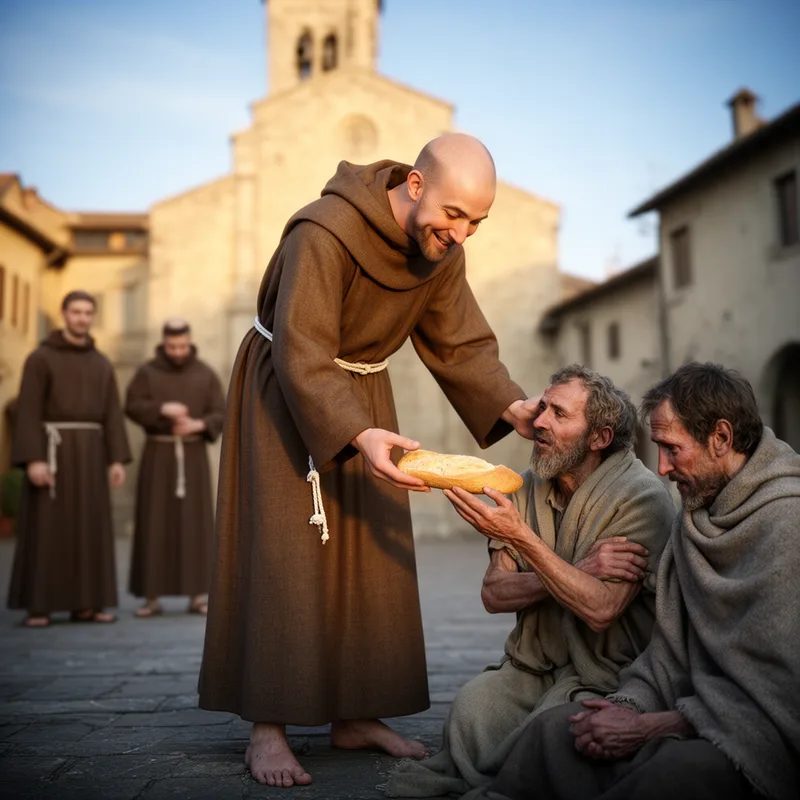
St. Francis
 5
6.8

- proper noun
- /seɪnt ˈfrænsɪs/
- Both St. Francis Cabrini and Memorial also provide a great deal of literature to assist parents and families.
- St. Francis of Assisi
Examples
-
For instance, a project underway in Switzerland is using VR to create a virtual world of Roman ruins, and an Italian project is re-creating a virtual Church of St. Francis at Assisi (Veltman 1996).
Academic text (1997) -
Certified Grief Counselor Becky Watkins reports that St. Francis Cabrini offers support groups such as The Compassionate Friends Inc., a group for parents of children who have died.
Academic text (1997) -
Many visitors come to admire the beautiful artwork inside the St. Francis Basilica in Assisi.
-
In his teachings, St. Francis emphasized the importance of caring for animals and the environment.
-
The feast day of St. Francis is celebrated each year on October 4th.
Synonyms
 5
5.6
An Italian monk and Catholic saint who founded a group of religious men
 5
6.4
An Italian monk and preacher who founded the Franciscan order and became a Catholic saint
 3
7.0
An Italian monk and preacher who founded the Franciscan order and cares for the poor and animals
 1
6.3
An Italian religious man of the 1200s who started the Franciscan order and cared for poor people and animals
Surface Forms
Morphology
St. + Francis
This is compositionally built from 'St.' (Saint) + the proper name 'Francis', so a learner who recognises the abbreviation 'St.' and the name will understand it denotes a saint named Francis. The construction is a common, cross-linguistic naming pattern (Saint + name) and therefore immediately interpretable, even if the learner would not know the detailed biography.
Etymology
St. Francis comes from Francis of Assisi, an Italian monk who gave up his money, lived simply, and cared for the poor and animals. Because people saw him as a 'saint' who lived in 'poverty' and peace, many churches, schools, and places use his name to show respect.