
Squamata


 1
9.9
- noun
- /skwɑːˈmɑːtə/
- Specialized
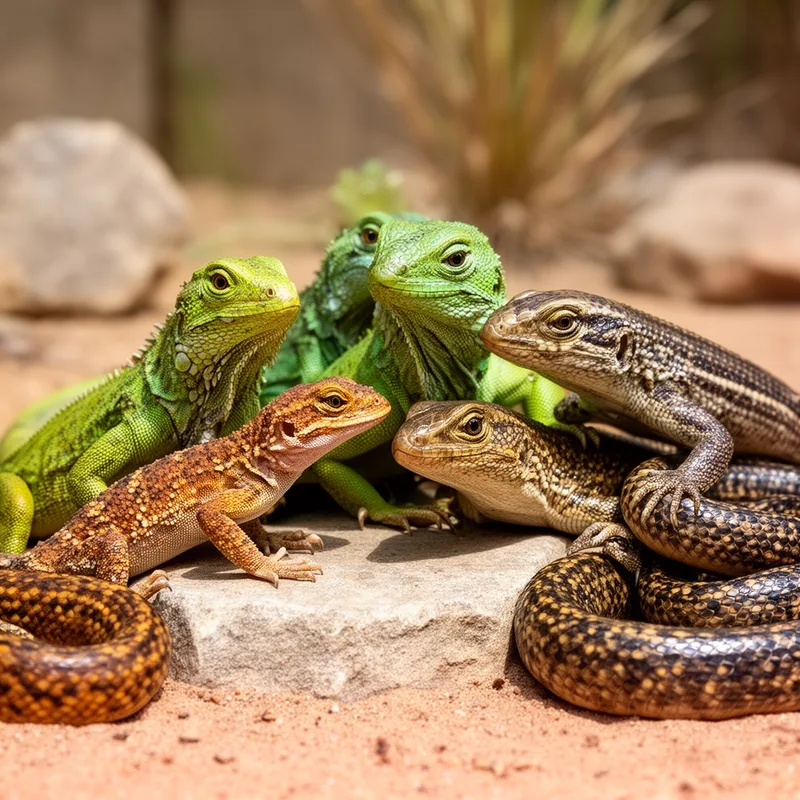
- They are members of the order Squamata, "the scaly ones," more popularly known as lizards and snakes.
- order Squamata
Examples
-
Squamata—lizards and snakes—have spread to almost every landmass and branched into more than 7,200 species.
Academic text (2006) -
Joints of the skull and jaws (arrows) help distinguish members of the order Squamata (lizards and snakes) from one another and from members of the closely related order Rhynchocephalia.
Academic text (2006) -
A cladogram, a diagram that shows evolutionary branching points, depicts probable interrelations among living families and other large groups in the order Squamata, as well as their shared ancestry with the Rynchocephalia, once a much more widespread and diverse group.
Academic text (2006) -
The largest reptiles, such as large pythons, belong to the order Squamata.
-
The order Squamata includes familiar species like the green lizard and the rattlesnake.
-
Many scientists study the biodiversity within the order Squamata to understand reptile evolution.
Synonyms

A large group of reptiles that includes snakes and lizards
Compounds
Surface Forms
Etymology
Squamata comes from the Latin squama, meaning 'scale'. Think of a 'scale' as the small hard plate on a fish or lizard, so Squamata are the 'scaled ones', which is why the name fits snakes, lizards, and other scaly reptiles.