

Spinoza
 7
9.6

- proper noun
- /spɪˈnoʊzə/
- Many philosophers studied the works of Spinoza to understand his impact on modern thought.
- Spinoza's philosophy
- influence of Spinoza
- Spinoza's thought
Loading YouTube…
Watch on YouTubeAnd so people like Benedict Spinoza, he clearly Cartesian.
- And so people like Benedict Spinoza, he clearly Cartesian.
- It could be Spinoza's God or substance, right?
- This is Plato, but Spinoza, the most logical of the rationalist.
- It targets Descartes, Spinoza, people like that.
- He believed in the God of Spinoza, the God of order, simplicity, harmony, beauty.
- You know, there's, for example, there's a statue if you go to Amsterdam, there's a statue of Baruch Spinoza in one of the squares there.
- OK, a lot more than Spinoza is coming out of that same.
- But when it opened up with, I suppose Spinoza and then but then country and the, and the, the, the Enlightenment era.
Examples
-
In a sense, Kant represents the exact opposite of Spinoza's philosophy.
Academic text (1993) -
Such was, in fact, the intention of Spinoza and Locke.
Academic text (1991) -
- Spinoza was a Jew.
-
And yet Spinoza didn't believe in the Holy Trinity.
-
There is thus a definite practical dimension to the Christian idea which Spinoza has incorporated into philosophy.
Academic text (1993) -
He believed in the God of Spinoza, the God of order, simplicity, harmony, beauty.
-
Prior to Spinoza, Descartes had kept the realms of faith and reason radically separate.
Academic text (1993) -
Unlike Descartes, mind (or the mental attribute), for Spinoza, was found throughout Nature.
Academic text (1991) -
Given the inherent anthropomorphism in Spinoza's thought, the move to subjective idealism after Kant was a natural one.
Academic text (1993) -
Baruch Spinoza was a significant figure in 17th-century philosophy, known for his pantheistic views.
Synonyms

A Dutch philosopher who said God and nature are the same and used reason to explain things
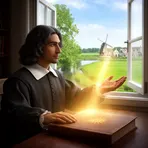
A Dutch philosopher who said God and nature are the same
Surface Forms
Etymology
Spinoza comes from a Spanish/Portuguese word espina meaning 'thorn' or 'thorn bush'. A helpful way to remember the Dutch philosopher is to imagine his ideas as 'sharp' and clear, like a thorn that cuts through confusion.