

Sorghum halepense
- noun
- /ˈsɔrɡəm ˌhɑːlɪˈpɛns/
- Specialized
- Many southern states regard Sorghum halepense as an invasive weed that is difficult to eradicate.
Examples
-
The farmer struggled to control the spread of Sorghum halepense in his pasture.
-
The farmer planted Sorghum halepense in his fields.
-
Sorghum halepense is notorious for invading crop fields and reducing yields.
-
Many people consider Sorghum halepense a troublesome weed.
-
Sorghum halepense can choke out other plants and disrupt the ecosystem in agricultural areas.
-
Farmers in the southern United States often report that Sorghum halepense competes aggressively with crops.
-
Controlling Sorghum halepense is essential for maintaining healthy pastures and maximizing crop yields.
Synonyms
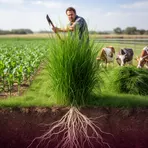
A tall grass that spreads underground and is used for animal food but is a harmful weed

A tall grass that spreads quickly and often grows as a harmful weed sometimes used for animal feed

A tall grass that spreads by creeping roots and feeds animals but can be a farm pest

A tall grass that lives for many years, spreads by underground stems, and is grown for farm animal food
Surface Forms
Morphology
sorghum + halepense
The form is a Latin binomial: the genus 'sorghum' is transparent, so a learner who knows that word can infer this is a kind/kind of sorghum (i.e. a plant). However the specific epithet 'halepense' is a Latin taxonomic marker (not in the learner dictionary) and does not convey the detailed meaning 'tall perennial grass/weed' to a B1 learner, so the full sense is not fully derivable.
Etymology
Sorghum halepense literally names the plant: Sorghum is the grain or grass type and halepense means 'from Aleppo', the old name for the Syrian city. So the name helps you remember it is a tall Mediterranean grass that is often a stubborn weed.

