
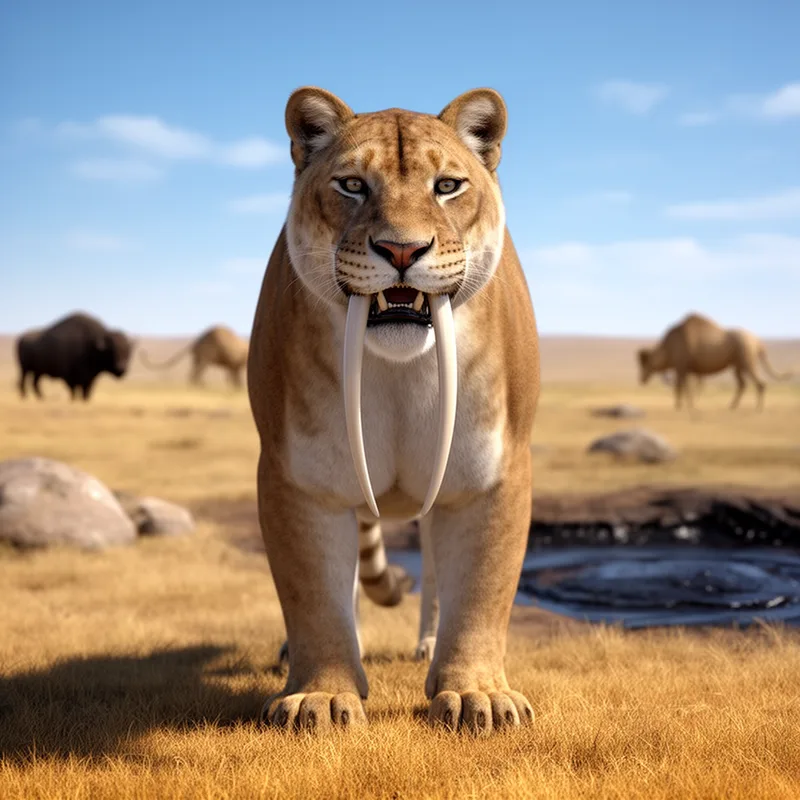
Smilodon californicus
- noun
- /ˈsmaɪləˌdɒn ˌkælɪˈfɔrnɪkəs/
- Specialized
- The massive canines of Smilodon californicus made it one of the most recognizable prehistoric predators.
Examples
-
Fossils of Smilodon californicus have been discovered in the tar pits of Los Angeles.
-
Scientists believe that Smilodon californicus hunted large mammals such as bison and camels.
-
The Smilodon californicus roamed North America during the Pleistocene.
-
Have you ever seen a Smilodon californicus skeleton in a museum?
-
Fossils of Smilodon californicus have been discovered in the tar pits of Los Angeles.
-
Scientists believe that Smilodon californicus hunted large mammals such as bison and camels.
-
The massive canines of Smilodon californicus made it one of the most recognizable prehistoric predators.
Synonyms

 4
7.7
4
7.7

A large extinct cat with long curved front teeth that lived long ago
 1
9.4
1
9.4
A large extinct cat with very long upper front teeth
Surface Forms
Morphology
Smilodon + californicus
This is a taxonomic binomial: 'Smilodon' denotes a saber-toothed cat and 'californicus' is a Latin adjectival epithet meaning 'from California' or 'Californian', so a learner who knows both parts can infer it refers to the Smilodon associated with California. Binomial formation is compositional and follows a predictable pattern, making the meaning directly derivable from the constituents.
Etymology
Smilodon californicus is a scientific name that paints a simple picture: Smilodon comes from words for 'knife' and 'tooth', and californicus means 'from California'. So the name helps you imagine a saber-toothed cat with long, knife-like teeth whose fossils were found in California.