
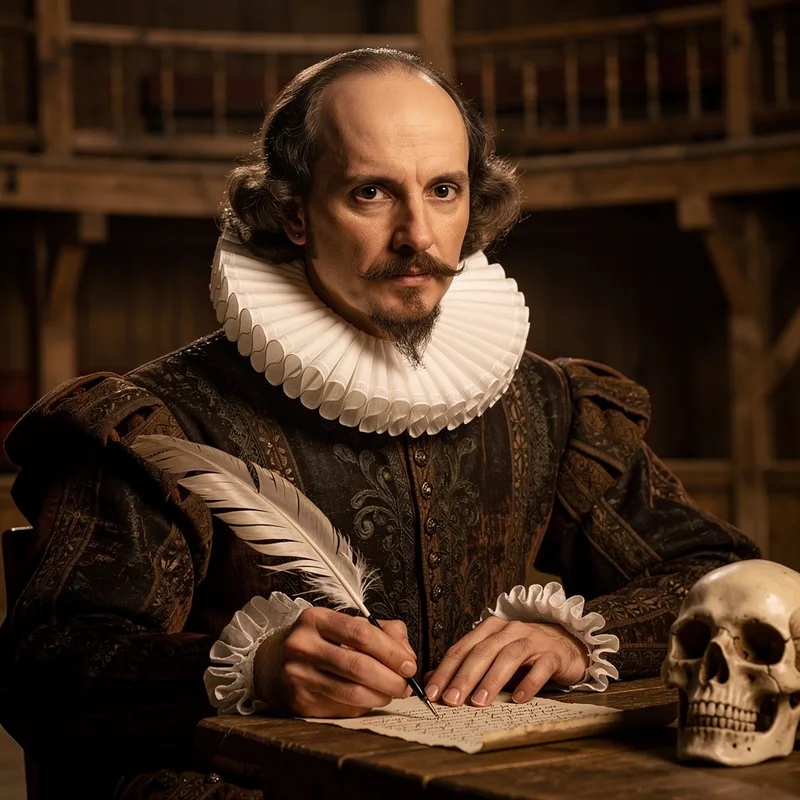
Shakespeare
 321
2.1
321
2.1

- proper noun
- /ˈʃeɪkspɪr/
- I've been teaching since then and directing Shakespeare in Chagrin Park in the summers.
- Shakespeare's plays
- Shakespeare wrote
- read Shakespeare
Loading YouTube…
Watch on YouTubeNo, no, but that's like asking Shakespeare, how do you write a masterpiece?
- No, no, but that's like asking Shakespeare, how do you write a masterpiece?
- But nothing I could learn about Shakespeare would change my mind about his plays.
- Mark Norman's son calls him up and says, what if Shakespeare had writer's block?
- They learn Shakespeare, they they learn Stanislavski.
- We were both the talking heads at a Shakespeare festival.
- There is something called direct address in Shakespeare.
- This is the complete works of Shakespeare.
- You or as did Shakespeare, things, things unfold.
- If a black guy played Shakespeare, as Eddie would say Shakespeare.
Examples
-
Charles has a welcoming treat: tickets for the Royal Shakespeare Company's Midsummer Night's Dream at the Barbican.
Fiction book (1993) -
The play "Hamlet" is one of Shakespeare's most famous works.
-
But nothing I could learn about Shakespeare would change my mind about his plays.
-
In Measure for Measure, Shakespeare demonstrates that justice is meant for all, not for a few.
Academic text (2011) -
I thought you hated Shakespeare.
-
One normally expects the turn in a Shakespeare sonnet to come in line 9.
Academic text (1999) -
Shakespeare's Hamlet couldn't be more exciting.
-
And here he's taking a line from Shakespeare's Midsummer's Night's Dream.
-
You should hear my father read romantic poetry out loud sometimes: Shakespeare's sonnets, Browning, Swinburne.
Fiction book (1993) -
William Shakespeare is renowned for his profound influence on the English language.
Synonyms

English writer of plays and poems from the 1500s and 1600s who many people call the greatest in English
An old spelling of the name William Shakespeare

A famous English writer from Stratford-upon-Avon who wrote plays and poems
Surface Forms
Etymology
The name Shakespeare comes from old English words shake 'to move quickly' and spear 'a long weapon'. It probably meant a person who 'shakes a spear', like a fighter, and a helpful way to remember the writer is to think of his words as a 'shaking spear' that changed English.