
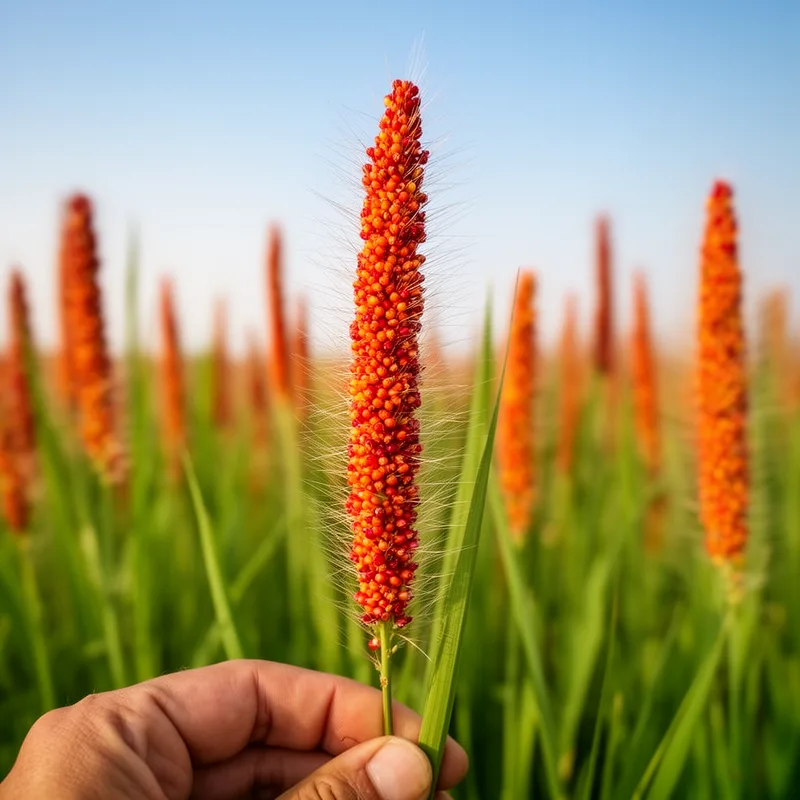
Setaria italica rubrofructa
- noun
- Specialized
- The long bristly spikes of Setaria italica rubrofructa distinguish it from other millet varieties.
Examples
-
Farmers in this region often cultivate Setaria italica rubrofructa for its nutritious, colorful grains.
-
Researchers are studying the drought resistance of Setaria italica rubrofructa compared to other millets.
-
The farmer planted Setaria italica rubrofructa this season.
-
Have you ever seen Setaria italica rubrofructa in bloom?
-
Farmers in this region often cultivate Setaria italica rubrofructa for its nutritious, colorful grains.
-
The long bristly spikes of Setaria italica rubrofructa distinguish it from other millet varieties.
-
Researchers are studying the drought resistance of Setaria italica rubrofructa compared to other millets.
Synonyms
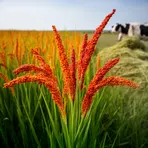
A grass with orange to red grains on long rough spikes grown for animal feed
Surface Forms
Morphology
Setaria + italica + rubrofructa
This is a botanical Latin binomial composed of a genus name ('Setaria' = a grass) plus Latin descriptors ('italica' = of Italy, 'rubrofructa' = red-fruited). The structure is compositional so a learner who knows those Latin constituents could infer a red/orange-grained variety of Setaria, but the Latinized elements are technical and not part of everyday English vocabulary for a B1 learner, making the meaning only partially predictable.
Etymology
Setaria italica rubrofructa comes from older words that describe the plant. Setaria comes from a word for 'bristle' because the plant has long bristly spikes, and rubrofructa means 'red fruit' for its orange to reddish grains, so the name gives the image of a bristly millet with red grains.

