
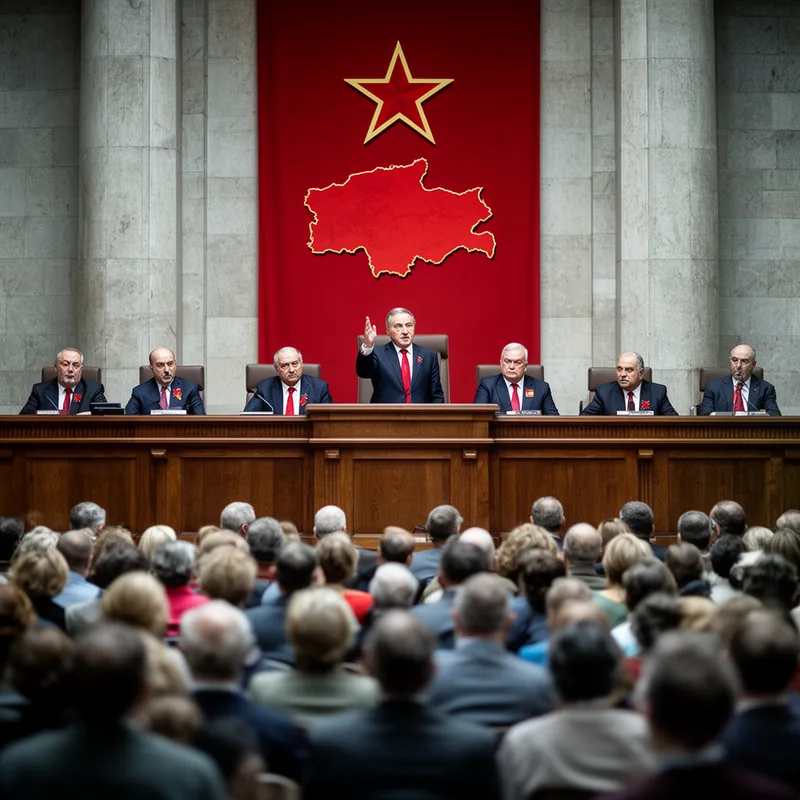
Serbo-Communist regime
- noun
- /ˈsɜrboʊˌkɒmjʊnɪst rɪˈɡeɪm/
- Archaic
- The fall of the Serbo-Communist regime led to significant political change in the region.
Examples
-
Opposition groups criticized the harsh policies implemented by the Serbo-Communist regime.
-
The Serbo-Communist regime was oppressive.
-
Many historians study the political tactics of the Serbo-Communist regime in the 20th century.
-
Yugoslavia had a Serbo-Communist regime.
-
Many historians study the political tactics of the Serbo-Communist regime in the 20th century.
-
Opposition groups criticized the harsh policies implemented by the Serbo-Communist regime.
-
The fall of the Serbo-Communist regime led to significant political change in the region.
Surface Forms
Morphology
Serbo-Communist + regime
The phrase is compositionally transparent: 'Serbo-Communist' combines a national/ethnic marker ('Serbo-' = relating to Serbia/Serbs) with 'Communist', and 'regime' means a governing system, so the overall meaning is a Communist government associated with Serbian influence. This nationality+ideology + regime pattern is regular and cross-linguistically common, so a B1 learner who knows the constituents should be able to infer the meaning.
Etymology
Serbo-Communist regime may come from joining Serbo (meaning 'Serbian') and Communist (meaning 'a communist government') to make a simple image: a government that mixes Serbian influence with communist rule. That's why the phrase is used today to describe a government with both Serbian and communist features.

