

Sedna
 1
9.9
1
9.9

- proper noun
- Specialized
- It says the dwarf planet Sedna lends further credence in the eyes of some to the existence of a companion star for the sun.
- Sedna, a large planetoid
- object known as Sedna
- discovered Sedna
Examples
-
So Sedna, the the first weird thing about Sedna is it's orbit cannot be explained and it's AKB just the.
-
But according to Wyatt legends, Sedna and her father fell through a hole and disappeared to the ablavin.
-
This is the same general spirit in which Itslk offers seal remains to Sedna, the Inuit goddess of the sea, so that she will continue to feed his people.
Academic text (2014) -
If gravitational distortion has the same effect, does that mean that if I throw a rock into space (I have a really big arm), after it passes, say, Sedna, it will literally be less massive than it was lying on the ground at my feet?
Blog text (22) -
PHOTO (COLOR): Artist's conceptualization of the sizes of Sedna and Quaoar, recently discovered objects outside Pluto's orbit.
Academic text (2004) -
The object, unofficially named Sedna, is thought to be about two-thirds the size of Pluto and larger than Quaoar (pronounced "KWAH-wahr"; relative to Pluto, the largest Kuiper Belt object found so far).
Academic text (2004) -
The first of those objects, dubbed Sedna, was discovered by Brown in 2003.
-
Currently, the farthest planet-like object we know of in our own system is Sedna.
-
Since its discovery on November 14, 2003, the Oort Cloud planetoid Sedna continues to surprise astronomers.
Synonyms
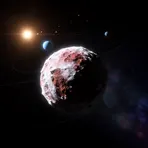
A distant small world beyond Neptune made of rock and ice
How Distant

Surface Forms
Etymology
Sedna comes from an Inuit story; she is a goddess of the 'sea' who lives in the deep, cold ocean. The distant icy planetoid was named Sedna because, like the goddess's remote home, it is far away, cold, and mysterious.