
Scotch laburnum
- noun
- UK
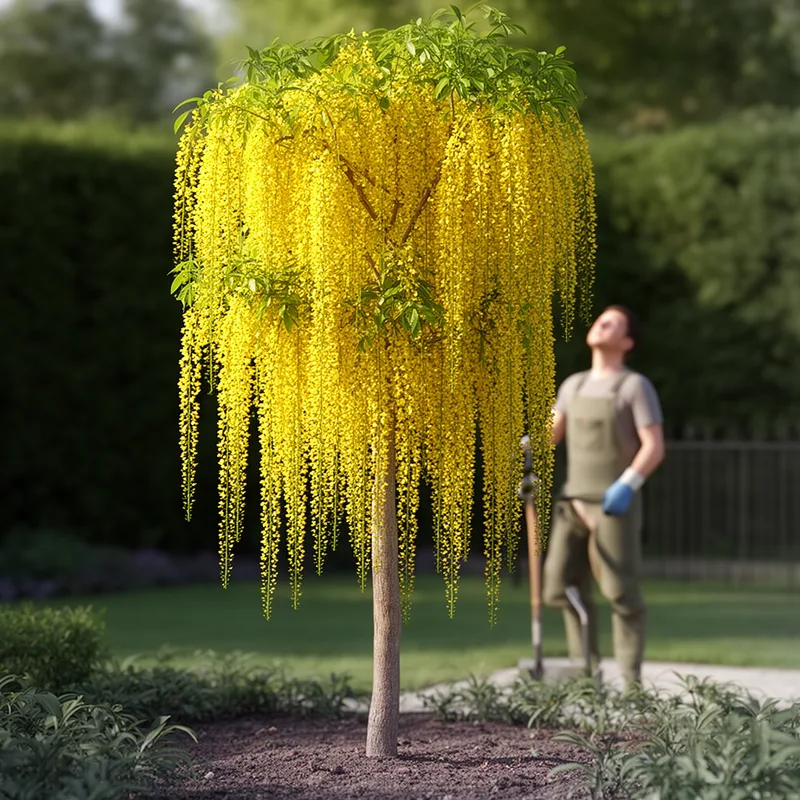
- The Scotch laburnum is prized for its long, cascading clusters of yellow flowers in spring.
Examples
-
Gardeners often plant Scotch laburnum as a decorative tree because of its vibrant appearance.
-
The Scotch laburnum blooms beautifully in the spring.
-
Be careful with the seeds of Scotch laburnum, as they are toxic if ingested.
-
Many gardeners love the Scotch laburnum for its vibrant yellow flowers.
-
The Scotch laburnum is admired for its stunning yellow flowers that attract many pollinators.
-
In spring, the branches of the Scotch laburnum create a beautiful display of long, pendulous blooms.
-
Gardeners often choose Scotch laburnum for its eye-catching flowers and graceful shape in landscaping.
Synonyms


 1
9.9
1
9.9
A small tree or shrub with bright yellow hanging flowers that is poisonous

A small tree or bush with bright yellow flowers from central and southern Europe

A small garden tree with hanging groups of bright yellow flowers
Surface Forms
Morphology
The phrase is a straightforward adjective + noun composition: 'Scotch' denotes origin/association with Scotland and 'laburnum' names the tree, so a learner who knows both words can infer it refers to a type/variety of laburnum connected with Scotland. There is no idiomatic or metaphorical shift here and this modifier+noun pattern is cross-linguistically common, making the expression transparent to learners.
Etymology
Scotch laburnum may get its name because the tree laburnum was often grown in Scotland, so people added 'Scotch' to show it was 'Scottish'. Its bright, hanging yellow flowers made it a popular garden tree, and that is why the name now means a decorative shrub with long yellow blooms.