
Sciurus carolinensis
- noun
- /ˈsaɪ.jʊr.əs ˌkær.əˈlɪn.ə.sɪs/
- Specialized
 :
Sciurus carolinensis
:
Sciurus carolinensis
- Researchers studied the population growth of Sciurus carolinensis after its introduction to England.
Examples
-
Sciurus carolinensis often outcompetes native squirrel species for resources.
-
The Sciurus carolinensis has adapted well to urban environments.
-
The Sciurus carolinensis is often seen in urban parks.
-
Have you ever spotted a Sciurus carolinensis in your backyard?
-
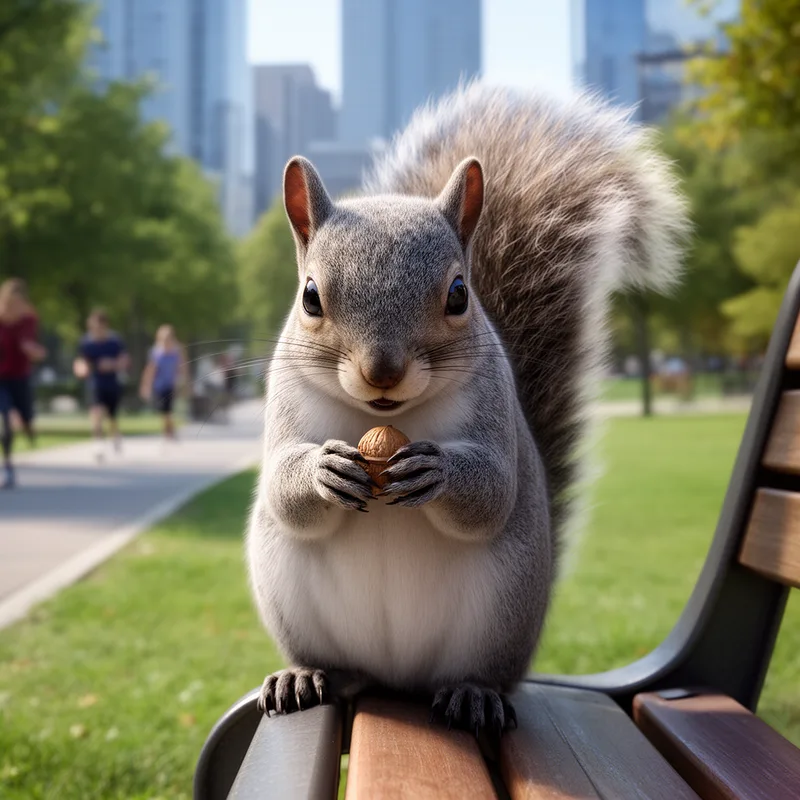
The Sciurus carolinensis is known for its bushy tail and gray fur.
-
In North America, the Sciurus carolinensis can often be seen searching for nuts.
-
Many people enjoy watching the Sciurus carolinensis as it leaps among the trees.
Synonyms

A common medium-sized squirrel from eastern North America with gray fur and a bushy tail
Surface Forms
Morphology
Sciurus + carolinensis
The form is a Latin binomial: knowing 'Sciurus' (a genus of squirrels) lets a learner infer this refers to a kind of squirrel, but 'carolinensis' is a Latin species epithet whose meaning ('from Carolina') and taxonomic function require familiarity with scientific naming. The overall specific identity ('Eastern gray squirrel') is not fully derivable by an average B1 learner from the parts alone, so the relation is only partial.
Etymology
Sciurus carolinensis may come from Greek words, with Sciurus tied to 'shadow' and 'tail' because the squirrel's big, bushy tail can look like a shadow over its body. Carolinensis means 'from Carolina', so the name reminds us of the squirrel's fluffy tail and where it comes from.

