
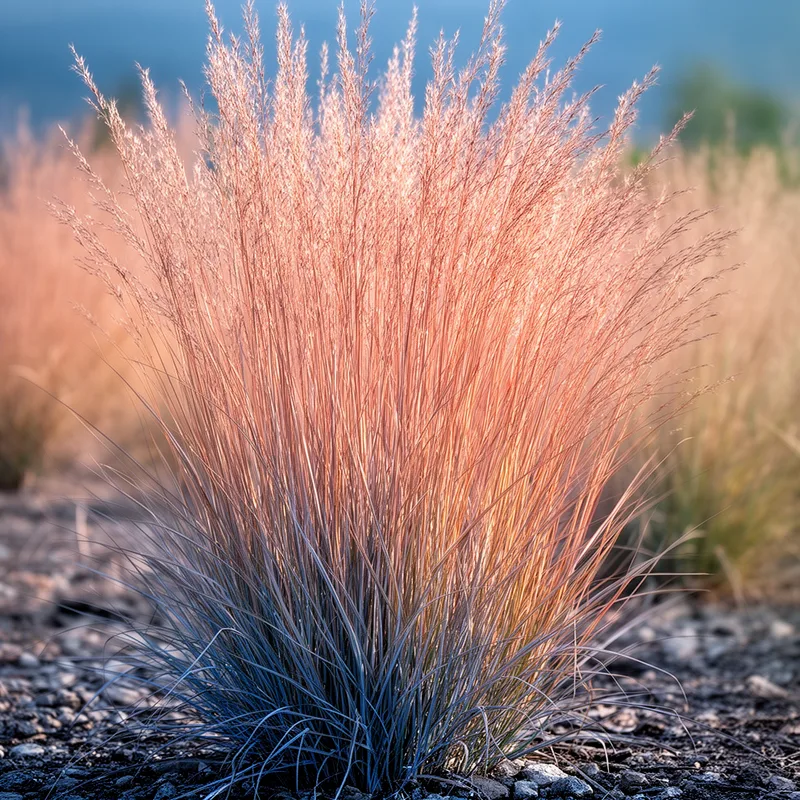
Schizachyrium scoparium
- noun
- /ˌskɪzəˈkɪrɪəm ˌskoʊˈpɛriəm/
- Specialized
- In autumn, Schizachyrium scoparium turns a beautiful pale bronze.
Examples
-
The garden featured Schizachyrium scoparium for its striking autumn color and resilience.
-
Schizachyrium scoparium is native to North America.
-
Many restoration projects use Schizachyrium scoparium to reestablish healthy prairie ecosystems.
-
Prairie ecologists often seek out Schizachyrium scoparium because of its importance to native grasslands.
-
Many restoration projects use Schizachyrium scoparium to reestablish healthy prairie ecosystems.
-
Prairie ecologists often seek out Schizachyrium scoparium because of its importance to native grasslands.
-
The garden featured Schizachyrium scoparium for its striking autumn color and resilience.
Synonyms
A hardy North American prairie grass with blue-green stems and leaves that turn bronze in autumn, also called little bluestem
Surface Forms
Morphology
Schizachyrium + scoparium
This is a Linnaean binomial (genus + species). Knowing 'Schizachyrium' as a grass genus allows a learner to infer that Schizachyrium scoparium is a species of that grass, but the specific common-name sense ('little bluestem') and descriptive traits are not derivable from the Latin epithet (and 'scoparium' is not lexically transparent). Binomial names are cross-linguistically predictable as species labels but do not fully convey ordinary lexical meaning, so the expression is only partially transparent.
Etymology
Schizachyrium scoparium may come from old Greek and Latin words that describe the grass: Schizachyrium points to 'split' seed parts and scoparium comes from a Latin word for 'broom', meaning a small, brush-like plant. So, the name helps you picture the 'little bluestem' grass with thin, split seed heads and a bushy look that turns pale bronze in autumn.

