

Saturnia
- noun
- /səˈtɜrniə/
- Specialized
 :
saturnia
:
saturnia
- The Saturnia moth is admired for its striking eye-like patterns on the wings.
Examples
-
The Saturnia moth, also known as the emperor moth, is found in various habitats around the world.
-
Larvae of Saturnia feed on a wide variety of trees and shrubs.
-
Scientists collected several Saturnia specimens during the field study in the forest.
-
Look at that beautiful Saturnia!
-
The Saturnia moth is stunning.
-
Researchers observed the life cycle of Saturnia moths in a controlled environment to study their behaviors.
-
In spring, the vibrant Saturnia moths emerge from their cocoons, showcasing their colorful wings.
Synonyms

Large insect with bright wide wings whose caterpillars make silk cocoons and which often has eye-shaped wing marks
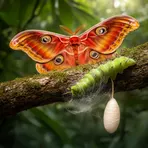
A large colorful moth whose caterpillars spin silk cocoons in tropical regions

A large moth with big wings whose caterpillars make silk
Compounds

- Specialized
A large moth in Europe and Asia with wings covered in many tiny scales and eye-like spots
Surface Forms
Etymology
Saturnia comes from Saturn, the Roman god and the planet, and names a group of large 'emperor' moths. Many of these moths have big round 'eye' spots or ring patterns on their wings, so the name helps you picture a small planet or ring and remember these showy moths.

