
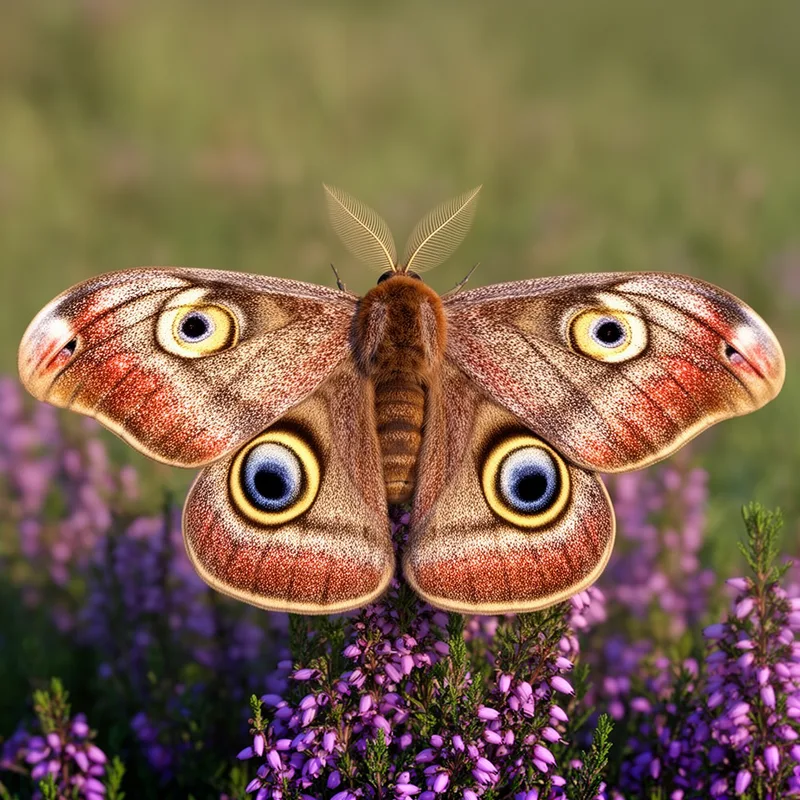
Saturnia pavonia
- noun
- Specialized
 :
Saturnia pavonia
:
Saturnia pavonia
- The Saturnia pavonia is easily recognized by the eye-like spots on its wings.
Examples
-
Many nature enthusiasts seek out the Saturnia pavonia during its brief flight period in spring.
-
Caterpillars of Saturnia pavonia feed on heather and other low shrubs.
-
The Saturnia pavonia is often found in temperate forests.
-
I spotted a Saturnia pavonia fluttering near the oak trees.
-
The Saturnia pavonia is easily recognized by the eye-like spots on its wings.
-
Many nature enthusiasts seek out the Saturnia pavonia during its brief flight period in spring.
-
Caterpillars of Saturnia pavonia feed on heather and other low shrubs.
Synonyms

 1
9.9
1
9.9

A large moth with thick, scaly wings found in forests of Europe and Asia

A large moth with patterned, partly see-through wings that lives in forests of Europe and Asia
Surface Forms
Morphology
Saturnia + pavonia
This is a Latin binomial (taxonomic) name acting as an arbitrary species label rather than a compositional English phrase. Even if a learner recognised 'Saturnia' as a genus, 'pavonia' is not interpretable from its parts and the common-name meaning ('small emperor moth') cannot be derived from the constituents, so it is not predictable to a B1 learner.
Etymology
Saturnia pavonia may come from old words: Saturnia refers to the Roman god Saturn and suggests an 'emperor' moth, while pavonia comes from Latin 'pavo' meaning 'peacock' because of the eye-like spots on its wings. So the name paints a picture of a grand, peacock-like moth, which helps you remember this species.