

Sarcodes sanguinea
- noun
- Specialized
- The bright red stems of Sarcodes sanguinea are often visible poking through the snow in early spring.
Examples
-
Unlike most plants, Sarcodes sanguinea does not rely on photosynthesis, as it is saprophytic.
-
Hikers in the Sierra Nevada may spot Sarcodes sanguinea growing beneath the pines.
-
The Sarcodes sanguinea blooms in early spring.
-
Have you seen a Sarcodes sanguinea before?
-
While walking through the snowy landscape, we discovered patches of Sarcodes sanguinea sprouting brightly among the white.
-
In the mountains of western North America, Sarcodes sanguinea can often be found emerging through the melting snow in early spring.
-
The unique appearance of Sarcodes sanguinea makes it a fascinating plant to observe as it grows in the cold, snowy environment.
Synonyms
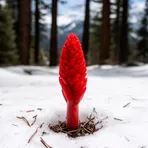
A bright red plant with a thick stem that grows in mountain forests while snow remains
Surface Forms
Morphology
Sarcodes + sanguinea
The binomial is descriptively compositional: 'Sarcodes' denotes a leafless red parasitic plant and 'sanguinea' (Latin-derived, meaning blood-red) would mark the species' red coloration, so the name's meaning can be derived from its parts if those roots are known. However, 'sanguinea' is a Latin-form epithet not found in everyday English and scientific names are not transparently parsed by most B1 learners, so the connection is only partially obvious.
Etymology
The plant name Sarcodes sanguinea paints a clear picture: Sarcodes comes from a word meaning 'flesh' and sanguinea means 'blood-red', so the name describes its fleshy, bright red stems. Because it is not green and does not use sunlight to make food, it grows from dead plants and fungi and often pokes through the snow, which is why the name fits today.

