
Saprolegnia ferax
- noun
- Specialized
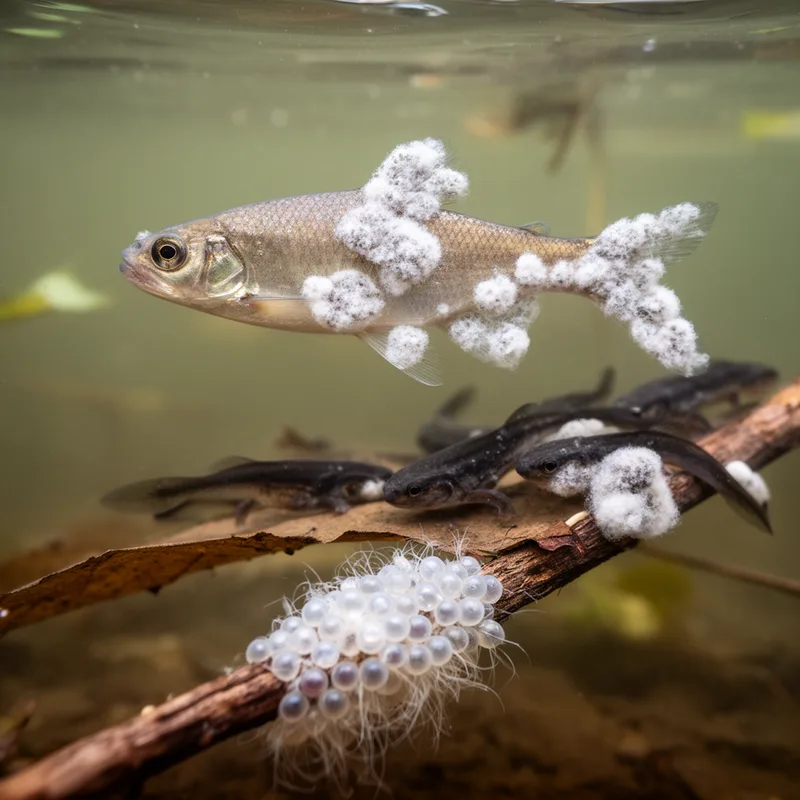
- The white hyphae of Saprolegnia ferax were visible on the fins of the infected tadpoles.
Examples
-
The biologist identified Saprolegnia ferax as the cause of the cottony growth on the fish.
-
Ponds with high organic content may encourage outbreaks of Saprolegnia ferax.
-
The Saprolegnia ferax infection spread rapidly among the fish.
-
Aquarists often worry about Saprolegnia ferax in their tanks.
-
The biologist identified Saprolegnia ferax as the cause of the cottony growth on the fish.
-
The white hyphae of Saprolegnia ferax were visible on the fins of the infected tadpoles.
-
Aquarists often worry about Saprolegnia ferax in their tanks.
Surface Forms
Morphology
Saprolegnia + ferax
The phrase is a scientific Latin binomial: knowing 'Saprolegnia' (an aquatic fungus genus) lets a learner infer this is a species of aquatic fungus, so part of the meaning is compositional. However, the species epithet 'ferax' is not transparent in everyday English and the specific pathogenic details (infecting fish, tadpoles, eggs, producing cottony growth) are technical and not derivable from the constituents, so the meaning is only partially recoverable.
Etymology
Saprolegnia ferax may come from old word parts sapro- meaning 'rotten' and ferax meaning 'fertile'. That picture helps: this water fungus makes white, cotton-like patches on dead or weak fish and eggs, so the name points to 'lots of rot'.

