
Rothko
 4
8.3

- proper noun
- /ˈrɔːθkoʊ/
- In Logan's play about Rothko, we learn that the apprentice is haunted by a bloody past.
- Mark Rothko
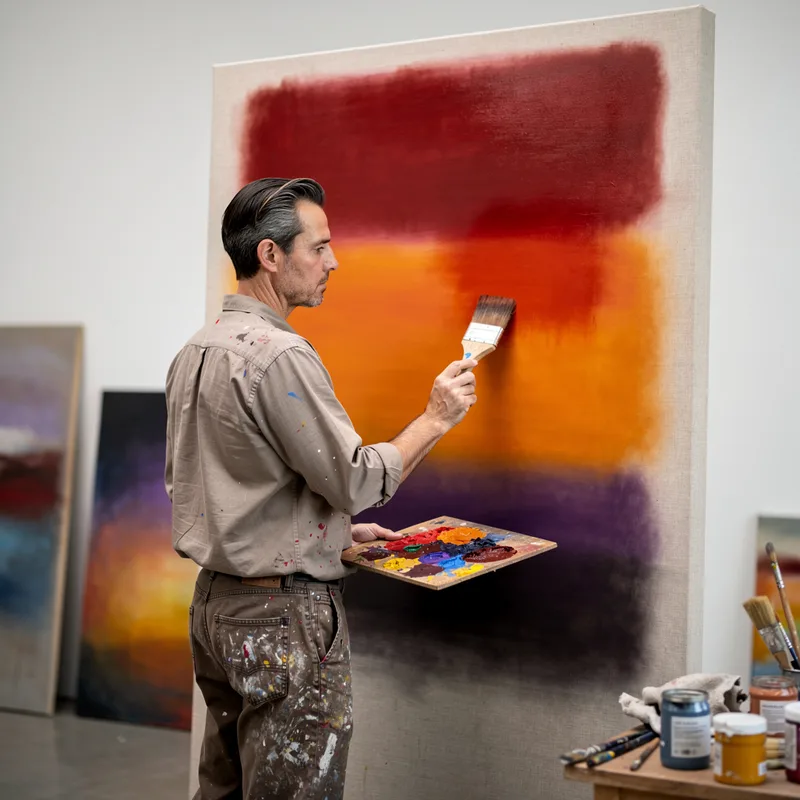
- Rothko painting
- Rothko's work
Loading YouTube…
Watch on YouTubeWhich is the real Rothko and which is the fake?
- Which is the real Rothko and which is the fake?
- And breaking away from that, Rothko kind of took the opposite approach.
- And in this case with Sugimoto and Rothko, I believe that the object is more of just a simple gesture of shape and light.
- Do we do we know that Rothko did it through that lens of understanding?
- How do I know I'm not doing the same thing with Rothko's feelings in Pale Fire?
- And the it's a collection that we put together largely ourselves of Rothko and Giacometti.
Examples
-
But Chagall's energy, like Rothko's, is entirely directed toward communication.
Academic text (2008) -
One quality that flows through a Rothko is tension.
Academic text (2011) -
If you stand and look at a Rothko or an abstract painting and pay attention to it, it will talk to you.
-
And in this case with Sugimoto and Rothko, I believe that the object is more of just a simple gesture of shape and light.
-
There's a Rothko in private hands that I have privileged knowledge of.
-
I hold up a print of a Rothko painting, Light Red Over Black (1957).
Academic text (2011) -
I have come to realize, though, two things about the red on which Rothko's compositions are so often built.
Academic text (2011) -
By the time it went on display at MoMA in 1949, Rothko had shifted from his surrealist stage to unfettered abstraction.
Academic text (2011) -
Pollock, Kusama, Motherwell, Rothko, Rauschenberg, Johns, Trombley, and Warhol, again, all were immigrants to New York.
-
Art lovers often seek out a genuine Rothko for its vibrant use of color and emotional depth.
Surface Forms
Etymology
Rothko is the artist's own name, a shortened form of his family name Rothkowitz that he adopted after moving to the United States. So, Rothko now stands for the painter Mark Rothko and his famous paintings of large, soft areas of color that are meant to create deep feelings.